Guitar lessons, manuals and repair shops all use a vocabulary that nobody explains on the first day. A teacher mentions "action", a forum post blames the "relief", a song sheet says "capo 2", and a chord chart labels one note "♭3". It is easy to nod along and stay confused.
This glossary collects the terms beginners meet most often and defines each one in plain English. It is grouped by subject rather than as one long A to Z list, so related ideas sit together: the parts of the instrument, setup and maintenance words, notes and chords, playing techniques, notation and practice, and electric guitar and gear. Within each group the terms are alphabetical. Where a subject has a full lesson on GuitarPlayerTV, the definition links to it.
Parts of the guitar
Body. The large part of the guitar that rests against you. On an acoustic it is a hollow box that amplifies the strings; on a solid-body electric it is a slab of wood that holds the pickups and bridge.
Bridge. The part on the body that anchors the strings at the far end from the headstock. On a steel-string acoustic the strings are usually held by bridge pins; on a classical guitar they are tied to the bridge; on electrics there are many designs, some with a tremolo arm.
Cutaway. A scooped section of the body next to the neck that lets your hand reach the highest frets more easily.
Fret. One of the metal wires set across the fingerboard. Pressing a string just behind a fret shortens the vibrating length and raises the pitch. "The 3rd fret" usually means the space just behind the third wire, counting from the nut.
Fretboard (fingerboard). The strip of wood on the front of the neck into which the frets are set. Common materials include rosewood, ebony and maple.
Fret markers (inlays). Dots or other shapes on the fretboard and the side of the neck, usually at frets 3, 5, 7, 9, 12 (often a double dot), 15 and 17, to help you find your place.
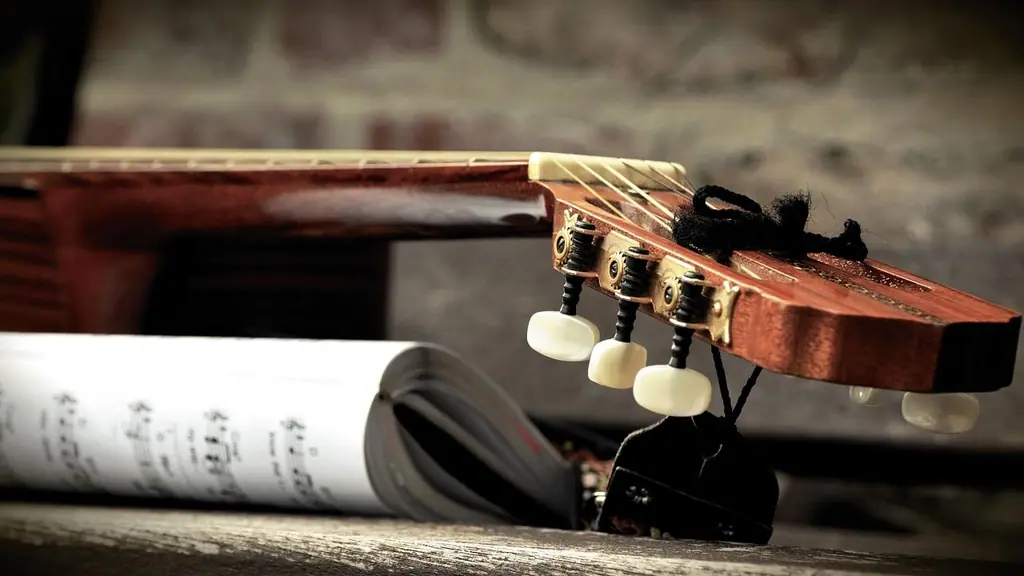
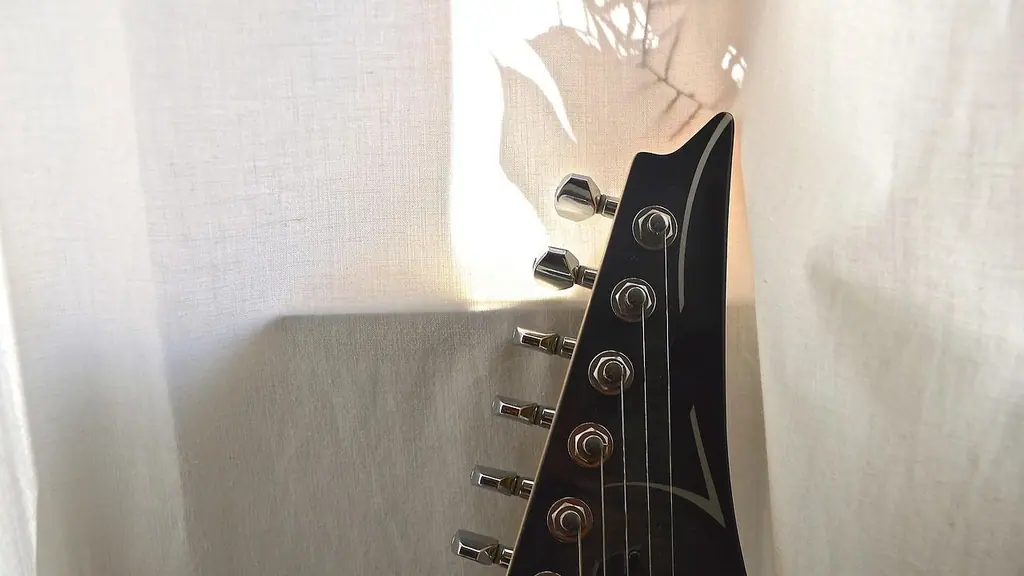
Headstock. The end of the neck that holds the tuners.
Neck. The long part between the body and the headstock that carries the fretboard. Its cross-section, the neck profile, affects how it feels in the hand.
Nut. The slotted strip, often made of bone, plastic or a synthetic material, at the headstock end of the fretboard. Together with the saddle it defines the vibrating length of the open strings. In a chord diagram, the thick line at the top represents the nut.
Saddle. The strip (or, on many electrics, the individual adjustable pieces) on the bridge that the strings pass over. Its height and position affect both action and intonation.
Soundhole. The opening in the top of an acoustic guitar. It is not where the sound "comes out" in a simple sense, but it is part of how the body resonates.
Strap buttons. The knobs on the body where a strap attaches.
Tuners (machine heads, tuning pegs). The geared knobs on the headstock that tighten or loosen each string. The word "tuner" is also used for the electronic device that tells you whether a string is in tune.
Our illustrated guide to the parts of the guitar shows where each of these sits on acoustic and electric instruments.
Setup and maintenance terms
Action. The height of the strings above the frets, usually measured at the 12th fret. High action makes a guitar harder to press down; very low action can cause buzzing. StewMac's setup guide gives typical electric-guitar figures of about 3/64 to 4/64 inch (roughly 1.2 to 1.6 mm) for the high E string and 3/64 to 5/64 inch for the low E, while stressing that preferences vary.
Gauge. The thickness of a string, given in thousandths of an inch. A set described as "10–46" has a .010-inch high E and a .046-inch low E. Players often name a set by its thinnest string ("10s"). D'Addario explains that, tuned to the same pitch on the same guitar, a heavier set has higher tension than a lighter one.
Humidity. The amount of moisture in the air. Wooden guitars, especially acoustics, swell and shrink as humidity changes, which can affect playability and, in extreme cases, crack the wood. Our maintenance guide covers safe storage.
Intonation. Whether notes stay in tune as you play up the neck. A guitar with good intonation sounds in tune at the 12th fret as well as on open strings. Technicians check it by comparing the 12th-fret harmonic with the note fretted at the 12th fret: if the fretted note is sharp, the saddle is moved away from the neck; if it is flat, the saddle is moved toward the neck.
Relief. A slight forward bow in the neck, measured as the gap between the strings (or a straightedge) and the frets around the middle of the neck. A little relief gives the vibrating string room to move without rattling. StewMac's guide describes measuring at the 7th or 9th fret and aiming for roughly .004 to .012 inch, depending on the player and the instrument.
Scale length. The vibrating length of the open string, from the nut to the point where the string touches the saddle. Two common electric-guitar figures are 25.5 inches (about 648 mm) and 24.75 inches (about 629 mm). D'Addario notes that the same strings tuned to the same pitch have more tension on a longer scale, which is one reason guitars with different scale lengths feel different.
Setup. The set of adjustments (relief, action, intonation and nut height) that make a guitar play comfortably and in tune. A good setup can make an inexpensive guitar much easier to learn on.
Truss rod. A metal rod inside the neck that counteracts the pull of the strings. Taylor describes it as a thin metal shaft running the length of the neck, usually adjusted through an access point behind the nut (on some acoustic models, through the soundhole). The truss rod adjusts relief; it is not the main way to set action. If you are not sure what you are doing, leave it to a technician.
Notes, chords and theory
Chord. Three or more different notes sounded together. On guitar, chords are usually named by their root and quality, such as C (C major) or Am (A minor).
Half step (semitone). The smallest distance between notes in Western music. On the guitar it is one fret. A whole step (tone) is two frets.
Interval. The distance between two notes, named by number and quality: a major third, a perfect fifth, an octave. Chord charts use interval numbers such as 3, ♭3, 5 and ♭7.
Key. The set of notes and the "home" note a piece is built around, such as G major or A minor.
Octave. The interval between a note and the next note of the same name, which has double the frequency. On any string, the 12th fret is one octave above the open string.
Open chord. A chord that uses some open (unfretted) strings, usually played near the nut. E minor, C, G and D are open chords.
Power chord. A two-note chord made of a root and a fifth (often with the root doubled an octave higher). It is labeled with a 5, such as E5, and is neither major nor minor. See our lesson on power chords.
Root. The note a chord or scale is named after. In a C major chord, the root is C.
Scale. A set of notes in a fixed order of steps. The major scale follows the pattern whole, whole, half, whole, whole, whole, half. A pentatonic scale has five notes; A minor pentatonic is A, C, D, E and G.
Standard tuning. The usual tuning of the six strings, from low to high: E2, A2, D3, G3, B3, E4. At the common reference pitch A4 = 440 Hz, the open strings vibrate at roughly 82.41, 110.00, 146.83, 196.00, 246.94 and 329.63 Hz. Our tuning reference plays each one.
Triad. A three-note chord built from a root, a third and a fifth. Open Music Theory, an open textbook, describes the four triad qualities: major, minor, diminished and augmented. C major is C, E and G; A minor is A, C and E.
Playing techniques
Alternate picking. Picking with strictly alternating downstrokes and upstrokes. It keeps fast passages even. Our alternate picking lesson has drills.
Arpeggio. The notes of a chord played one after another instead of together.
Barre. Pressing several strings at the same fret with one finger, usually the index finger laid flat. A barre chord uses this to make a movable shape: slide it up or down the neck and you get the same type of chord with a new root.
Bend. Pushing or pulling a fretted string sideways to raise its pitch, common in blues and rock lead playing. Bends are described by how far the pitch rises: a half-step bend or a whole-step bend.
Fingerstyle. Playing with the fingers (and often the thumb) instead of a pick. Fingers are named p, i, m and a in classical guitar teaching (thumb, index, middle and ring).
Hammer-on and pull-off. Ways of sounding a note without picking it. In a hammer-on, a fretting finger taps onto the string firmly enough to sound a higher note; in a pull-off, a finger lifts off with a slight sideways flick to sound a lower note. Together they are called legato techniques.
Harmonic. A bell-like tone produced by touching a string lightly over certain points (such as directly above the 12th fret) without pressing it down, then picking it.
Muting. Silencing strings you do not want to sound. Palm muting means resting the side of the picking hand lightly on the strings near the bridge for a short, chunky sound.
Slide. Moving a fretting finger along the string from one fret to another while it is still sounding. It also names a style of playing with a tube (a "slide") worn on a finger.
Strumming. Brushing the pick or fingers across several strings in one motion, down or up. Our guide to strumming patterns builds rhythm from a constant down-up motion.
Vibrato. A small, repeated variation in pitch, made by gently bending and releasing a held note. It makes long notes sing.
Notation and practice terms
BPM (beats per minute). The speed of the beat. A metronome set to 60 BPM clicks once per second. Our metronome is free to use.
Chord diagram (chord box). A small grid showing where to place your fingers for a chord, with strings as vertical lines and frets as horizontal lines. Our guide on how to read chord diagrams explains every symbol.
Count-in. Counting the beats aloud ("1, 2, 3, 4") before playing so everyone starts together at the same speed.
Lead sheet (chord chart). Music written as chord names above lyrics or bar lines, leaving the player to choose the shapes and rhythm.
Tab (tablature). A system for writing guitar music with six horizontal lines for the strings and numbers for frets. As Berklee Online's guide to guitar notation explains, the top line represents the high E string. Basic tab shows which notes to play but usually not their rhythm. See how to read guitar tab and rhythm.
Warm-up. A short routine of gentle exercises at the start of practice. Our 10-minute warm-up is a good template.
Electric guitar and gear
Amplifier (amp). The device that makes an electric guitar's signal loud enough to hear through a speaker. Types include tube (valve), solid-state and modeling amps.
Capo. A clamp placed across all the strings at one fret. It raises the pitch of every open string by one half step per fret, so familiar chord shapes sound in a higher key.
Distortion, overdrive and fuzz. Effects that deliberately clip the guitar signal to make it sound gritty, thicker and more sustained. They differ in how strongly and how smoothly they clip.
Effects pedal (stompbox). A small foot-operated unit that changes the sound between guitar and amp: delay, reverb, chorus, wah and many more. Our guide to effects pedals explains each type.
Humbucker. A pickup with two coils wired so that the electrical hum each coil picks up cancels out, while the string signal adds together. Humbuckers are generally quieter and thicker-sounding than single-coils.
Pickup. A device under the strings of an electric guitar, made of magnets and coils of wire, that turns string vibration into an electrical signal. A single-coil pickup has one coil; it is often bright and clear but can pick up hum. Our article on pickups goes deeper.
Pickup selector. The switch that chooses which pickup, or which combination of pickups, is heard. Common types are three-way and five-way switches.
Tremolo. Strictly, a regular rise and fall in volume, as produced by a tremolo effect. Confusingly, the "tremolo arm" (whammy bar) on many electric guitars changes pitch, which is technically vibrato. Both uses are common, so check the context.
Using this glossary
Nobody needs to memorize all of these at once. A practical approach:
- Learn the parts first. Being able to name the nut, frets, saddle and tuners makes every other lesson easier to follow.
- Pick up theory words as you need them. "Root", "triad" and "interval" make much more sense once you have played a few chords. Our music theory essentials introduce them in order.
- Use setup words to describe problems. If a guitar is hard to play or will not stay in tune, "the action feels high" or "it's sharp at the 12th fret" helps a technician help you.
- Come back when you meet a new word. This page is meant as a reference. Bookmark it, and browse our learning resources section for more.
Sources
- What Does a Guitar Truss Rod Do?, Taylor Guitars
- Electric Guitar and Bass Assembly Guide, Part 5: Setup, Stewart-MacDonald (StewMac)
- All About Guitar String Tension, D'Addario
- Guitar Notation Basics, Berklee Online, Take Note
- Triads, Open Music Theory (open textbook)