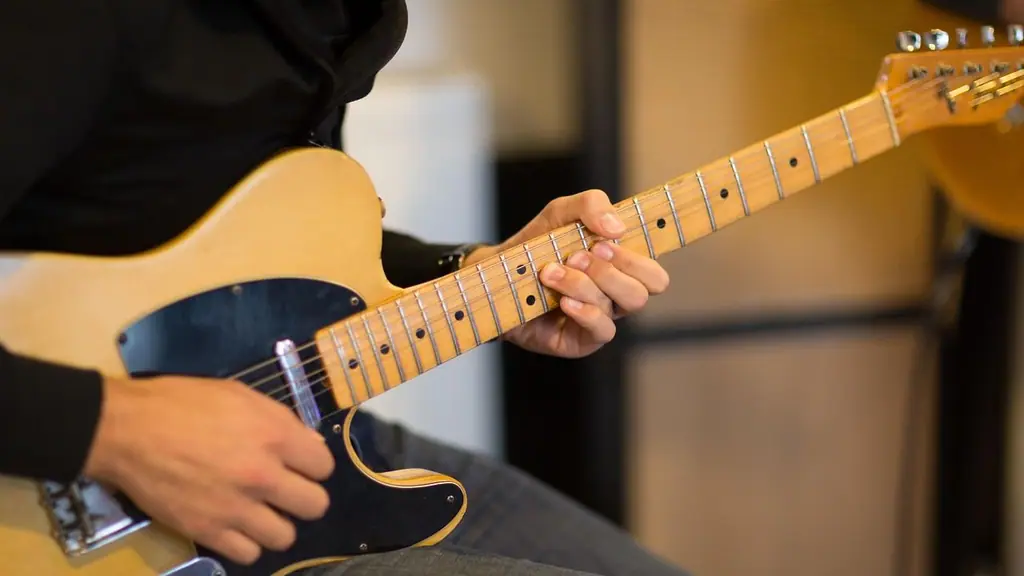
If you have listened to rock, punk or metal, you have heard power chords: thick, punchy two- or three-note shapes that slide around the neck and sound huge through a distorted amplifier. They are often the first "real" electric guitar sound a beginner learns, and for good reason. One shape gives you every chord in every key, and you do not need a barre.
This lesson explains what a power chord is in terms of intervals, why it is neither major nor minor, how to play the movable shapes with roots on the 6th and 5th strings, how to keep unused strings quiet, and why the power chord and distortion suit each other so well. (Playing styles such as palm muting and riff writing belong in rock guitar basics; this article is about the chord itself.)
What a power chord is
A power chord contains just two different notes: a root and the fifth above it. Most shapes also double the root an octave higher. That is why it is written with a 5: E5, A5, G5.
Take E5 as an example. Its notes are E, B and E.
- From E up to B is a perfect fifth: seven half steps (E–F–F♯–G–G♯–A–A♯–B).
- From E up to the next E is an octave: twelve half steps.
The Open Music Theory textbook lists the perfect unison, fifth and octave among the harmonically consonant intervals, the ones heard as stable rather than needing to resolve. A power chord is built entirely from them.
Why it is neither major nor minor
A normal major or minor chord is a triad: root, third and fifth. The third decides the chord's quality. MacEwan University's open music theory textbook explains that lowering the third of a major triad by a semitone turns it into a minor triad, while the root and fifth stay put.
A power chord leaves the third out. With no third, it has no major or minor quality, so the same E5 works in a song in E major or E minor. That ambiguity is part of its appeal: the power chord sounds strong and open rather than happy or sad, and the bass line, melody or vocal decides the mood.
| Chord | Notes | Quality |
|---|---|---|
| E major | E, G♯, B | Major (major third G♯) |
| E minor | E, G, B | Minor (minor third G) |
| E5 | E, B (+ E) | Neither: no third |
The movable shapes
Root on the 6th string
Place your index finger on the 6th string at any fret. That note is the root. Your ring finger goes on the 5th string two frets higher (the fifth), and your little finger on the 4th string, also two frets higher (the octave).
Root on the 5th string
The same shape moves across one string: index on the 5th string (root), ring and little fingers on the 4th and 3rd strings two frets higher. Don't strum the 6th string.
The two-finger version
You can also leave out the octave and play just the root and fifth with your index and ring fingers. It is lighter and quicker to move, and many players use it for fast riffs. In tab, G5 and C5 as two-note shapes look like this:
e|----------|
B|----------|
G|----------|
D|-------5--|
A|--5----3--|
E|--3-------|
     G5  C5
Seymour Duncan's guide to barre chords makes a point that applies here too: guitar chords without open strings are movable shapes, so one fingering gives you a chord at every fret. Name the power chord after the note under your index finger.
| Fret | Root-6 shape | Root-5 shape |
|---|---|---|
| 1 | F5 | B♭5 |
| 3 | G5 | C5 |
| 5 | A5 | D5 |
| 7 | B5 | E5 |
| 8 | C5 | F5 |
| 10 | D5 | G5 |
If you don't yet know the note names along the two lowest strings, our lesson on learning the notes on the fretboard is the quickest way to make these shapes useful.
Muting the strings you are not playing
On an acoustic guitar, an accidental open string is a small blemish. Through a distorted amplifier, it becomes a roar. Clean power chords depend on keeping every unused string silent.
- Mute below the root. For a root-5 shape, let the very tip of your index finger touch the 6th string lightly, just enough to stop it ringing.
- Mute above the shape. Let the underside of your index finger rest lightly across the higher strings, without pressing them down. They stay silent even if your pick hits them.
- Relax the fretting hand slightly between chords. Releasing pressure (without lifting) stops the chord instantly, which gives riffs their tight, chopped sound.
- Aim the pick. Even with muting, strum only the two or three strings of the chord.
Try this: play a root-6 G5 at the 3rd fret, then deliberately strum all six strings. With good muting you should hear only the power chord. If any other string rings, adjust your index finger until it is silent. Then do the same with a root-5 C5.
Why power chords and distortion go together
Distortion makes a guitar signal richer by adding extra frequencies: overtones of each note and, when two notes sound together, new tones based on the differences and sums of their frequencies. Whether those extra tones sound good depends on the interval.
With a perfect fifth, the frequencies are in a simple relationship (very close to 3:2), so most of the added tones line up with notes already in the chord. For example, the low E (about 82.41 Hz) and the B above it (about 123.47 Hz) differ by about 41 Hz, which is very close to E an octave below the root. The chord just sounds bigger. With more complex chords, the extra tones fall between the notes and clash, producing a rough, muddy sound.
Research supports what guitarists have long heard. In a study at the University of Huddersfield, Jan-Peter Herbst analyzed electric guitar chords at different levels of distortion and ran a listening test. Power chords and major chords were rated as significantly more pleasant than minor and altered dominant chords when played with an overdriven or distorted tone. The study notes that this matches musical practice: cleaner rock styles use major chords often, while heavily distorted styles such as heavy metal rely largely on power chords.
For more on the different flavors of distortion, see our guide to fuzz, overdrive and distortion.
Practice routine
| Minutes | Exercise | Tempo |
|---|---|---|
| 2 | Open E5, A5 and D5, four downstrokes each | 70 BPM |
| 3 | Root-6 shape: slide from 1st to 3rd to 5th fret, four strums each | 70 BPM |
| 3 | Root-5 shape: same frets | 70 BPM |
| 4 | Change between root-6 and root-5 at the same fret (for example G5 to C5 at the 3rd) | 60–80 BPM |
| 3 | Original riff below, eighth-note downstrokes | 70 BPM, then faster |
Here is a short original riff to practice moving between shapes, played with downstrokes, two per beat:
e|-----------------|-----------------|
B|-----------------|-----------------|
G|-----------------|-----------------|
D|-----------------|-------------2-2-|
A|-2-2-2-2-5-5-5-5-|-2-2-2-2-5-5-0-0-|
E|-0-0-0-0-3-3-3-3-|-0-0-0-0-3-3-----|
   E5      G5        E5      G5  A5
Count "1 & 2 & 3 & 4 &" and keep the picking hand moving evenly. Use the metronome and only speed up when every change lands cleanly.
Where power chords fit
Power chords are a starting point, not a replacement for full chords. Because they have no third, they cannot by themselves tell you whether a song is major or minor, and they can sound thin on an unamplified acoustic. Once they feel comfortable, the natural next step is full barre chords, which use the same root positions on the 6th and 5th strings. You will find all the shapes on this page, plus their notes, in the chord library and on the power-chord page of our printable chord charts. For a refresher on the symbols in the diagrams, see how to read guitar chord diagrams.
Sources
- Distortion and Rock Guitar Harmony: The Influence of Distortion Level and Structural Complexity on Acoustic Features and Perceived Pleasantness of Guitar Chords, Jan-Peter Herbst, University of Huddersfield
- Intervals, Open Music Theory (open textbook)
- Triad Qualities, Introduction to Music Theory and Rudiments, MacEwan University
- The Art of the Barre, Seymour Duncan, The Player's Room