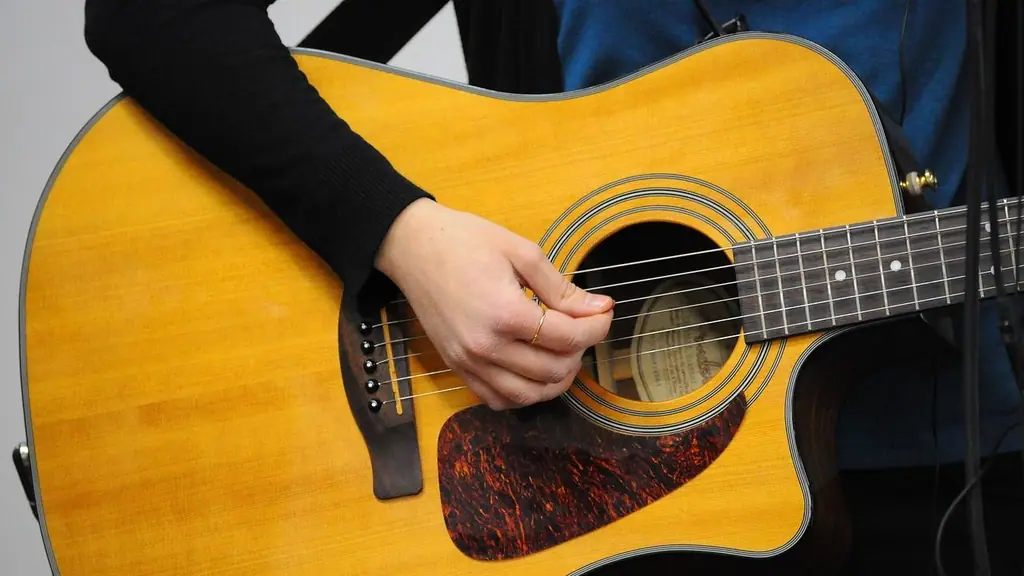
Single-note lines that sound uneven, notes that seem to trip over each other, a picking hand that tires quickly or locks up as the tempo rises: these are nearly always picking-hand problems, and most of them come from not having a consistent system for which direction the pick moves.
Alternate picking is that system. You pick down, then up, then down, then up, strictly alternating, whatever the fretting hand is doing. This lesson explains how to set up the pick and the motion, works through drills on one string and then across two, explains the "inside" and "outside" string changes that trip most players up, and gives you a metronome ladder for building speed without building tension.
What alternate picking is, and why it works
With downstrokes only, the pick has to travel back up past the string without sounding it before each note, so half of every motion is wasted. With alternate picking, the return journey plays the next note. The result is roughly twice as many notes for the same hand movement, and a steady, predictable motion that locks to the beat.
The key word is strict. In basic alternate picking:
- Notes that fall on the beat are played with a downstroke.
- Notes between the beats are played with an upstroke.
- If you pause or skip a note, the hand keeps moving, just as it does in strumming.
That rule keeps your picking hand in time even when the fretting hand is busy. It is the same pendulum motion described in our lesson on strumming patterns, made smaller and aimed at one string.
Setting up: grip, angle and motion size
Premier Guitar's lesson on alternate picking makes the point that respected players hold the pick in quite different ways, and that there is no single correct grip. What they share is a relaxed picking hand and well-synchronized hands. As a starting point that suits most people:
- Grip. Hold the pick between the pad of your thumb and the side of the first joint of your index finger. Let only a small amount of the tip show, a few millimeters. Squeeze just enough not to drop it.
- Angle. Keep the pick roughly flat to the string, or tilted slightly so its edge slices through. Too steep an angle makes the pick scrape; too much pick digging into the string makes it catch.
- Motion size. Move the pick only just past the string on each stroke. Large swings take time to reverse, which limits speed and accuracy.
- Anchor, lightly. Many players let the side of the palm brush the strings near the bridge, or rest a finger lightly on the body, for reference. A light touch is fine; pressing down creates tension.
- Where the motion comes from. Most players use a mix of wrist and forearm rotation. Whatever you use, it should feel easy enough to keep up for a minute without fatigue.
If you are unsure about the pick grip or how you are sitting, our guide to holding the guitar and pick without tension is the place to start.
Drill 1: One string, open
Begin with no fretting at all, so you can listen only to the picking hand. Play the open 1st string, down-up, as even eighth notes with a metronome at 60 BPM. The top row is the count and the second row the pick direction.
   1 & 2 & 3 & 4 &
   D U D U D U D U
e|-0-0-0-0-0-0-0-0-|
B|-----------------|
G|-----------------|
D|-----------------|
A|-----------------|
E|-----------------|
Listen for whether the upstrokes are as loud and clear as the downstrokes. They usually are not at first. Yamaha educator Robbie Calvo notes that downstrokes tend to be naturally stronger than upstrokes, and suggests a short daily exercise using only upstrokes to even them out. Try one minute of upstrokes only on the open string, then return to alternating and listen again.
Drill 2: One string, fretted notes
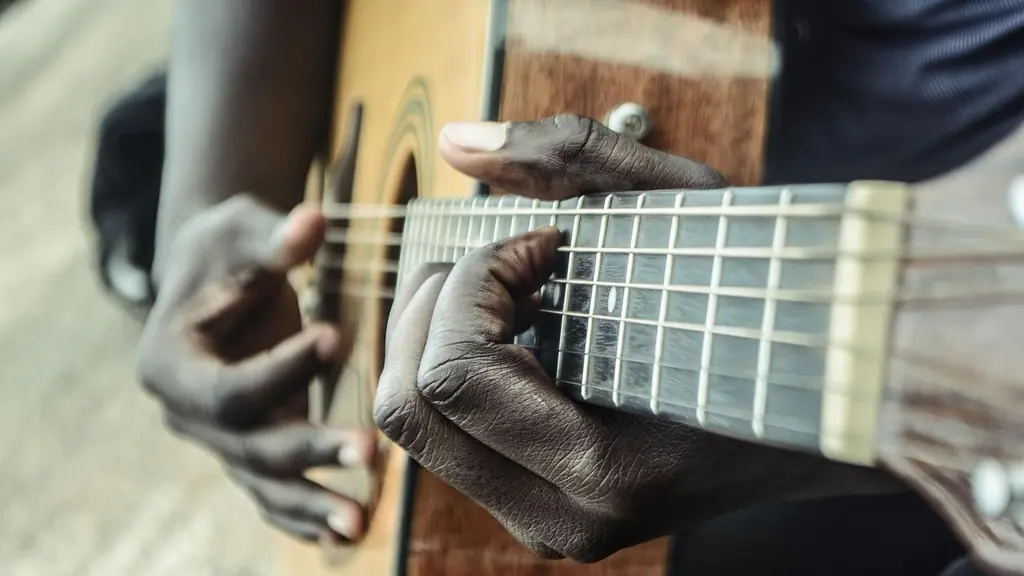
Now add the fretting hand. This drill stays on the 2nd string at the 5th fret, using one finger per fret: index at 5, middle at 6, ring at 7, little finger at 8.
e|---------------------------------|
B|-5-6-7-8-7-6-5-6-7-8-7-6-5-6-7-8-|
G|---------------------------------|
D|---------------------------------|
A|---------------------------------|
E|---------------------------------|
Pick D U D U throughout, two notes per click. The notes are E, F, F♯ and G, and back down. Focus on synchronization: each finger should land at the same instant the pick strikes. Premier Guitar's lesson stresses that many players concentrate so hard on the picking hand that they forget the fretting hand must be exactly in time as well.
Changing strings: inside and outside picking
String changes are where alternate picking gets difficult, because the pick has to clear one string to reach the next. There are two situations:
- Outside picking: the pick strikes the two strings from their outer sides. Going from a lower-pitched string to a higher one, that means a downstroke on the lower string followed by an upstroke on the higher string.
- Inside picking: the pick strikes both strings from the space between them. Going from lower to higher, that means an upstroke on the lower string followed by a downstroke on the higher string.
Neither is right or wrong; strict alternate picking produces both, and you need both. Many players find one noticeably harder than the other, so it is worth drilling them separately.
Drill 3: Two strings, outside then inside
This drill alternates one note on the 2nd string with one note on the 1st string, both at the 5th fret (E and A).
   bar 1: outside   bar 2: inside
e|---5---5---5---5-|---5---5---5---5-|
B|-5---5---5---5---|-5---5---5---5---|
G|-----------------|-----------------|
D|-----------------|-----------------|
A|-----------------|-----------------|
E|-----------------|-----------------|
For the first bar, start with a downstroke on the 2nd string. Every change is now outside picking. For the second bar, start with an upstroke on the 2nd string. Every change is now inside picking. Same notes, completely different feel. Play each bar four times in a row before switching, at a tempo where every note is clean.
Drill 4: Three notes per string
With three notes on each string, the string changes alternate between outside and inside picking, so you practice both in one exercise. This is a C major scale fragment on the 5th, 4th and 3rd strings:
   D U D U D U D U D U D U D U D U D U
e|-------------------------------------|
B|-------------------------------------|
G|-------------4-5-7-7-5-4-------------|
D|-------3-5-7-------------7-5-3-------|
A|-3-5-7-------------------------7-5-3-|
E|-------------------------------------|
Up the scale the notes are C, D, E on the 5th string, F, G, A on the 4th, and B, C, D on the 3rd. Then come back down, playing the top note twice so that every string still gets three notes. Use your index finger for the lowest fret on each string, and fingers that fit the stretch for the rest (on the 3rd string, index at 4, middle at 5 and little finger at 7).
Building speed: the metronome ladder
Speed is a by-product of accuracy and relaxation, not something you can force. The University of Texas Center for Music Learning, in its tips for effective practice, advises working mostly on material you can nearly play, varying tempo slightly from day to day, and dividing practice into short segments rather than long ones. Applied to picking, that suggests a ladder:
- Choose one drill. Find the fastest tempo at which you can play it perfectly, and relaxed, four times in a row. Write that number down.
- Raise the metronome by 4 BPM and play it four times. If it is still clean and relaxed, raise it again.
- When you reach a tempo where notes blur or your forearm tightens, go back down 8 to 10 BPM and play it twice, perfectly, to finish.
- Next session, start a few BPM below yesterday's best, not at it.
| Week | Drill focus | Daily time (suggested) |
|---|---|---|
| 1 | Drills 1 and 2 at eighth notes | 5 minutes |
| 2 | Drill 3, outside and inside | 5 minutes |
| 3 | Drill 4, ascending and descending | 5–8 minutes |
| 4 | All four drills on the ladder, logging tempos | 8–10 minutes |
Keep a written log of tempos, such as the one on our printable practice sheets. Progress over weeks is easy to miss without one.
Relaxation and common problems
- Tension creeping in. Stop, shake your hand out, and restart below your top tempo. Premier Guitar's first rule is to keep the picking hand relaxed and light. Tension is the most common reason picking speed stalls.
- Upstrokes missing the string. Make the motion smaller rather than bigger, and play Drill 1 slowly while watching the pick.
- Hands out of sync. Slow down and listen for the moment the note sounds. If you hear a gap or a smear between notes, the fretting finger is landing early or late.
- The pick slips or rotates. Show a little less pick, or try a pick with a textured surface.
- Getting lost at string changes. Isolate just the two notes either side of the change and repeat them until they are smooth, then put them back in context.
Safety: tired muscles are normal after focused practice; pain is not. The Hospital for Special Surgery recommends warming up before playing and taking regular breaks during long sessions. If you feel pain, numbness or tingling in your hand, wrist or forearm, stop, rest, and see a healthcare professional if it does not settle.
Putting it to use
Alternate picking pays off fastest when you use it on real music. Apply it to the scale shapes in guitar scales for beginners, or to the chromatic and spider exercises in our 10-minute warm-up routine. When the drills feel automatic, take them into the pentatonic phrases in how to start improvising, where even, confident picking makes simple ideas sound finished.
Sources
- Cram Session: Alternate Picking, Premier Guitar
- Elevate Your Guitar Playing in 30 Days, Yamaha Music
- Tips for Effective Practice, Center for Music Learning, The University of Texas at Austin
- Injury Prevention Tips for Musicians, Hospital for Special Surgery