A packet of strings carries a surprising amount of information: two numbers such as "10-46" or "12-53", a material such as "nickel wound" or "phosphor bronze", sometimes a word like "coated" or "normal tension". To a new player it looks like code, and it is easy to come home with a set that does not suit the guitar, or the hands, at all.
This guide decodes the packet. You will learn how gauges are measured and named, what the main string materials are for, how electric, steel-string acoustic and classical strings differ, and how to tell when a set has reached the end of its life. It deliberately recommends no brand: every major maker produces the same basic types, and the right one depends on your guitar, your hands and your music.
What the gauge numbers mean
A string's gauge is its diameter in thousandths of an inch. A "10" is 0.010 in (about 0.25 mm) thick; a "46" is 0.046 in (about 1.17 mm). Sets are named by their thinnest and thickest strings, so "10-46" means the 1st string (high E) is .010 and the 6th string (low E) is .046.
Here is a complete regular-light electric set, as listed for one widely sold nickel-wound set, and a light steel-string acoustic set:
| String | Electric 10-46 | Acoustic light 12-53 |
|---|---|---|
| 1st (high E) | .010 plain | .012 plain |
| 2nd (B) | .013 plain | .016 plain |
| 3rd (G) | .017 plain | .024 wound |
| 4th (D) | .026 wound | .032 wound |
| 5th (A) | .036 wound | .042 wound |
| 6th (low E) | .046 wound | .053 wound |
Notice the 3rd string. On most electric sets the G is a plain steel wire, which makes it easy to bend; on most acoustic sets it is wound, which gives a fuller sound but makes bends much harder. That single difference explains a lot about why lead playing feels different on the two instruments.
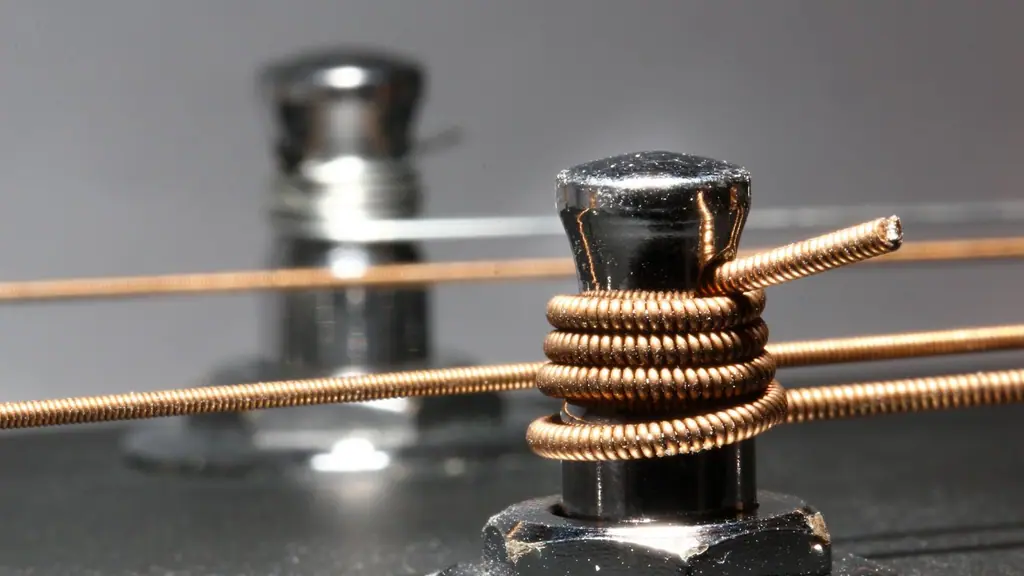
Plain strings are a single steel wire. Wound strings have a steel core (often six-sided, or "hex", in modern sets) with a second wire wrapped tightly around it, which adds mass so the string can sound a low note at a playable tension.
Lighter or heavier?
For the same tuning and scale length, a heavier string needs more tension to reach pitch. That has predictable effects:
- Lighter gauges are easier to press and bend, so they are kinder to new fingertips. They can sound thinner and are more prone to buzzing if you strum hard or the guitar's action is very low.
- Heavier gauges give more volume and a fuller low end, especially on acoustic guitars, and stay steadier under a heavy pick attack. They need more finger strength and can make bends hard work.
Common electric sets run from 9-42 ("super light") through 10-46 ("regular light") to 11-49 ("medium"), and D'Addario notes that most players settle somewhere between 9s and 11s. Common steel-string acoustic sets are labeled extra light (often 10-47), custom light (often 11-52), light (12-53) and medium (13-56). Names are not standardized between makers, so always read the actual numbers.
Changing gauge changes the setup. Moving more than one step heavier or lighter alters the pull on the neck and the height of the strings, and it may need a truss-rod or nut adjustment. If the guitar starts to buzz or feel very stiff after a gauge change, ask a guitar technician to check it.
If you are just starting, it is reasonable to use the gauge the guitar was set up with, or one step lighter on an acoustic if pressing the strings is painful. Our guide to choosing between acoustic and electric explains why the difference in string tension matters so much for beginners.
Electric string materials
Electric guitar pickups are magnets, so electric strings must be made of a magnetic metal, at least at the core. The wound strings come in three main types:
- Nickel-plated steel is the everyday standard: a steel wrap with a thin nickel plating, magnetic, bright but balanced. D'Addario describes it as the alloy used in most popular electric sets.
- Pure nickel has a warmer, rounder, slightly lower-output sound and a smooth feel. It was the common electric string of the 1950s and early 1960s, and is often chosen for vintage-style tones.
- Stainless steel is the brightest and most aggressive, and lasts well, but it feels slightly rougher and is harder on nickel frets.
There is also a choice of winding. Nearly all modern guitar strings are roundwound, with a round wrap wire that gives brightness and grip. Flatwound strings use a flat ribbon wrap that feels smooth, cuts finger squeaks and sounds warm and mellow, which is why they are associated with traditional jazz.
Acoustic string materials
On a steel-string acoustic the sound comes from the top vibrating, not from a magnet, so the wrap wire can be made of bronze alloys that suit the instrument's tone.
- 80/20 bronze (80% copper, 20% zinc, according to Martin) starts very bright and crisp, and mellows fairly quickly.
- Phosphor bronze (Martin describes its version as 92% copper and 8% tin phosphide) sounds warm and balanced and resists corrosion better. Martin calls its 92/8 phosphor bronze its best-selling string material.
- Silk and steel strings have a steel core with silk or nylon fibers under the wrap. They have lower tension and a soft, mellow tone, and are sometimes used on small-bodied or older guitars or by fingerstyle players.
Never fit electric strings to a steel-string acoustic in the hope of making it easier to play; D'Addario advises against it, as the sound is thin and the setup is designed for acoustic sets. A lighter acoustic gauge is the better answer.
Classical (nylon) strings
Classical and flamenco guitars use a completely different kind of string. The three treble strings are solid nylon (or a similar polymer, sometimes with added carbon for a brighter, more direct tone). The three bass strings have a core of many fine nylon filaments wrapped with metal wire, most often silver-plated copper.
Nylon sets are graded by tension rather than by gauge, using names such as low, normal (medium) and high (hard). Higher tension gives more volume and projection but needs firmer fingers; normal tension is the usual starting point. As with steel strings, the labels are not standardized, so one maker's "high" can be close to another's "normal".
Most nylon strings are tie-end: you tie them at the bridge. Some are made with a ball end for quicker changes.
Safety: never put steel strings on a guitar built for nylon strings. Steel sets pull far harder on the neck and bridge than a classical guitar is designed to withstand, and can damage it.
Our introduction to classical guitar basics covers how the nylon-string instrument differs in posture and technique.
Coated strings
Coated strings have a very thin polymer layer over the wound strings (and sometimes the plain ones). The coating keeps sweat and dirt out of the gaps between the windings, so the strings keep their tone longer. D'Addario lists the trade-offs plainly: coated strings resist corrosion, hold their tone and reduce finger noise; uncoated strings sound a little brighter and feel more traditional. If your strings go dull within a couple of weeks, or you have sweaty hands, coated strings are worth trying.
How to tell when strings need changing
There is no fixed schedule. Taylor Guitars says a touring player might restring every couple of weeks, while a casual player can often go two or three months, and D'Addario describes a range of a few weeks to a few months depending on playing time, environment and coating. Instead of counting days, look and listen for these signs, all drawn from manufacturers' guidance:
- The sound has gone dull. Chords sound flat and lifeless and notes die away quickly.
- The guitar will not stay in tune, or notes higher up the neck sound out of tune with the open strings even when the open strings are correct.
- The strings look discolored or rusty, or feel rough when you slide a finger along them.
- The windings are coming loose or a string is kinked, often at the bridge or where it presses on the frets.
- A string has broken. The others are probably near the end too; it is usually best to replace the whole set.
You can make strings last longer by washing your hands before you play, wiping the strings with a dry cloth afterward, and keeping the guitar in a stable environment. Taylor also points out that high humidity corrodes strings faster; our guitar maintenance guide explains humidity and storage.
A quick checklist before you buy
- Which kind of guitar? Electric (magnetic, usually nickel-plated steel), steel-string acoustic (bronze alloys), or classical (nylon, graded by tension). They are not interchangeable.
- What gauge is on it now? Start there, or one step lighter if it is hard to play. A big change may need a setup.
- What do you want more of? Brightness (80/20, stainless), warmth (phosphor bronze, pure nickel), longevity (coated) or ease of playing (lighter gauge).
- Buy two sets, so you have a spare when one breaks.
When the new set arrives, our step-by-step guide to changing guitar strings shows how to fit them so they stay in tune. For more on the rest of your gear, browse the gear topic or start with our overview of effects pedals.
Sources
- D'Addario XL Nickel Wound Electric Guitar Strings (set gauges), StewMac
- How Electric Guitar Strings Are Made, D'Addario
- Everything You Need to Know About Acoustic Guitar Strings, D'Addario
- String Materials Explained, C.F. Martin & Co.
- Classical Guitar Strings, Thomann Online Expert
- How Often Should You Change Guitar Strings?, Taylor Guitars