The classical guitar is the quieter, warmer cousin of the steel-string acoustic. It has nylon strings, a wider neck, and a playing tradition with its own posture, its own plucking strokes and a large repertoire written down in standard notation. Many people start on one because nylon strings are kinder to the fingertips; others come to it later, drawn by the sound of solo pieces in which one guitar plays melody, bass and harmony at once.
This guide covers the essentials for a beginner: what makes a classical guitar different, how to sit with it, the two basic plucking strokes (rest stroke and free stroke), how classical guitar music is written, and the kinds of pieces you will meet. If you have not played fingerstyle before, our pillar lesson on fingerstyle guitar for beginners introduces the p, i, m and a finger names used throughout.
How a classical guitar differs from a steel-string acoustic
Yamaha's musical instrument guide sets out the main construction differences clearly.
| Feature | Classical (nylon-string) | Steel-string acoustic |
|---|---|---|
| Treble strings | 1st–3rd: single nylon strings | 1st–2nd: plain steel |
| Wound strings | 4th–6th: many fine nylon strands wrapped with metal wire | 3rd–6th: steel wrapped with metal |
| Neck width at the nut (typical Yamaha models) | About 52 mm | About 43 mm |
| Neck cross-section | Rounder, close to a semicircle | Slimmer, closer to a triangle |
| String height | Generally higher | Generally lower |
| Usually played with | Fingers | Pick or fingers |
The wider neck is not an accident. Yamaha explains that nylon strings vibrate in wide arcs when plucked, so they need more space between them, and the extra width also lets the fretting fingers come down on one string without touching the next. The trade-off is that full chords can feel like a bigger stretch than on a slim steel-string neck.
The sound is softer and rounder, and very responsive to touch: small changes in where and how you pluck change the tone noticeably. Yamaha also credits the Spanish maker Antonio de Torres, born in 1817, with enlarging the guitar's body and string length into what became the modern classical guitar.
Safety: classical guitars are built for the lower tension of nylon strings. Never fit steel strings to one. When changing nylon strings, an adult should supervise children, and everyone should keep their face away from the strings while tuning up to pitch.
Posture: the classical sitting position
Classical guitarists play seated, and the traditional position raises the neck so that the fretting hand can reach every part of the fingerboard comfortably. Yamaha's guide describes the basic position, and music educator Kenny Baker uses the same approach with his classes:
- Sit toward the front of a chair without arms, with your back upright but not stiff. Baker points out that you do not need the chair back at all.
- Place your left foot on a footstool (for right-handed players), with your feet about shoulder-width apart.
- Rest the guitar's waist on your left thigh, with the lower part of the body between your legs and the back of the guitar against your body.
- Raise the neck so that the headstock is roughly at eye level.
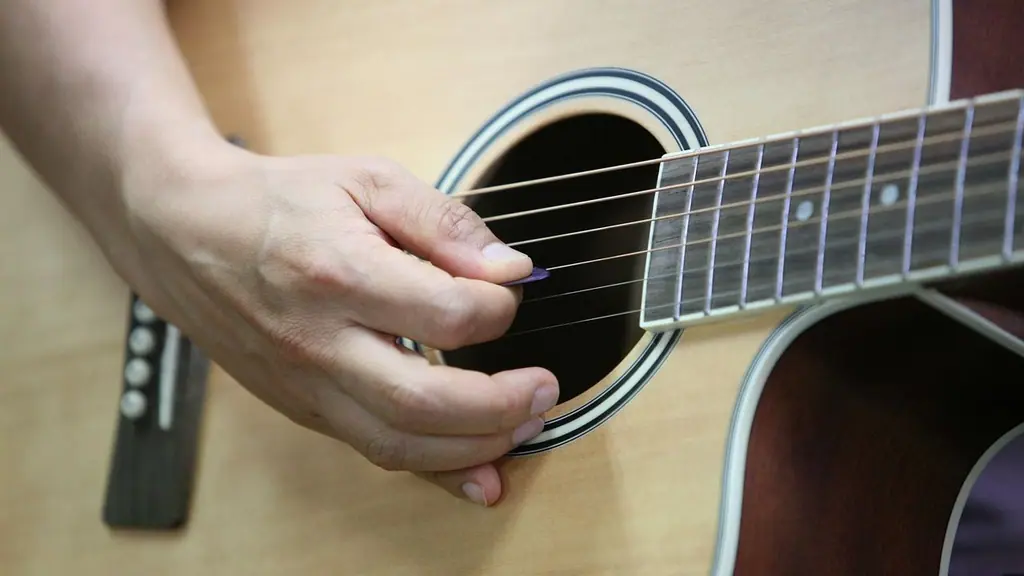
- Rest your right forearm on the upper edge of the body, so that the hand hangs relaxed over the strings near the soundhole.
- Keep the left thumb behind the neck, roughly opposite the middle finger, and fret with the fingertips. On a classical guitar the left thumb does not wrap over the top of the neck.
A footstool is the traditional tool, but many players prefer a support that sits on the left leg and raises the guitar instead, which keeps both feet flat on the floor. Either is fine; what matters is that the guitar is stable, the neck is raised, and your shoulders are level and relaxed. Adjust the height as you grow or as your comfort changes. Our guide to holding the guitar without tension has more on spotting tension.
Rest stroke and free stroke
Classical technique uses two fundamental ways of plucking with the fingers. Bradford Werner, a classical guitar teacher who taught for many years at the Victoria Conservatory of Music, advises learning both so that each is available when the music calls for it.
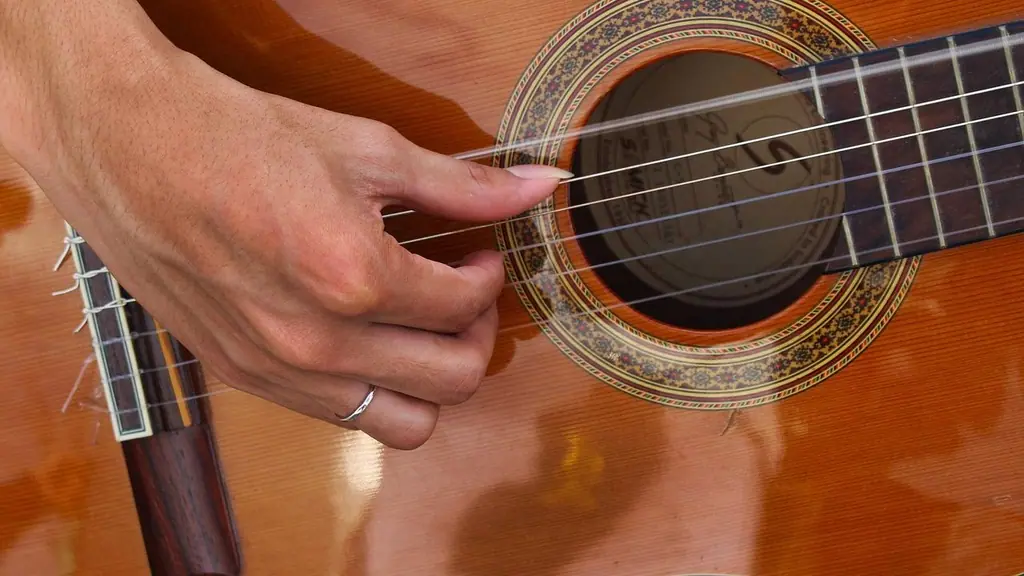
- Rest stroke (apoyando): the finger plucks the string and follows through to come to rest on the next string (the adjacent lower-pitched string). It gives a full, strong tone and is often used for melodies and scales.
- Free stroke (tirando): the finger plucks the string and passes above the next string without touching it, moving toward the palm. This is the stroke for arpeggios and chords, where the neighboring strings must keep ringing.
Baker starts his students with rest stroke, alternating i and m, because it gives a confident sound and is easier to learn; free stroke comes later. That is a sensible order to follow on your own.
Exercise 1: rest stroke on one string
    1  2  3  4    1  2  3  4
    i  m  i  m    i  m  i  m
e|--0--0--0--0-|--0--0--0--0-|
B|-------------|-------------|
G|-------------|-------------|
D|-------------|-------------|
A|-------------|-------------|
E|-------------|-------------|
Play the open 1st string with rest strokes, alternating i and m, one note per beat at 60 BPM on a metronome. After each stroke the finger should land on the 2nd string and stay there until the other finger plays. Pluck by moving the finger from the knuckle, through the string, rather than hooking the string outward.
Exercise 2: a melody with rest strokes
    1  2  3  4    1  2  3  4
    i  m  i  m    i  m  i  m
e|--0--1--3--1-|--0----------|
B|-------------|-----3--1--0-|
G|-------------|-------------|
D|-------------|-------------|
A|-------------|-------------|
E|-------------|-------------|
Keep alternating i and m as the melody moves from the 1st string to the 2nd. The notes are E, F, G, F, E, D, C, B. Fret the F with your first finger and the G and D with your third finger. Never let the same finger play twice in a row.
Exercise 3: free-stroke arpeggio on open strings
    1  &  2  &  3  &
    p  i  m  a  m  i
e|-----------0-------|
B|--------0-----0----|
G|-----0-----------0-|
D|-------------------|
A|-------------------|
E|--0----------------|
This uses only open strings, which together sound an E minor chord, so you can watch your picking hand. The thumb plays the 6th string; i, m and a play the 3rd, 2nd and 1st strings with free strokes, curling toward the palm and clearing the next string. Let every note ring until the next time that string is played.
Try this: for one week, play each exercise for two minutes a day. Listen for an even volume between i and m in exercises 1 and 2, and for all four strings ringing together by the end of each bar in exercise 3.
Reading classical guitar music
Most classical guitar music is written in standard notation rather than tab, and learning to read it opens up a huge library. A few conventions are specific to the guitar:
- The treble clef, an octave up. Yamaha's guide notes that guitar music is usually written an octave higher than it sounds, so that it fits on the treble staff.
- Fretting-hand fingers are shown as numbers next to the notes: 1 index, 2 middle, 3 ring, 4 little finger, and 0 for an open string.
- Picking-hand fingers are shown with the letters p, i, m and a.
- Strings are shown as numbers in circles, from ① (high E) to ⑥ (low E).
- Positions are often shown with Roman numerals, such as V for fifth position.
If notation is new to you, our lesson on reading guitar tab and rhythm covers note values and counting, which carry straight over to standard notation.
The music: what you will play
Classical guitarists learn from a mix of studies (short pieces that each focus on a technique) and repertoire. You will meet a few broad categories:
| Category | What it is | Examples of composers (public domain) |
|---|---|---|
| Studies and études | Short pieces built around one technique: arpeggios, scales, slurs | Fernando Sor (1778–1839), Ferdinando Carulli (1770–1841), Mauro Giuliani |
| Renaissance and Baroque | Music originally for lute or vihuela, often arranged for guitar | Many anonymous pieces and dances |
| Romantic character pieces | Expressive short works, often Spanish in style | Francisco Tárrega (1852–1909) |
| Twentieth-century and later | Music from Spain, Latin America and beyond | Many composers; check copyright before copying scores |
Because these older composers' works are in the public domain, many original editions are freely available from the IMSLP Petrucci Music Library, including large collections of studies by Sor and Carulli. Beginner method books from the same period are still widely used as teaching material.
Common problems
- The guitar slides around. Check that the waist sits on your left thigh and that the footstool or support is high enough.
- Rest strokes sound thin. Pluck through the string toward the next string, not outward; let the tip of the finger and, if you use them, a short smooth nail meet the string together.
- Free strokes catch the next string. Curl the finger slightly more toward the palm.
- Fretting-hand thumb creeping over the neck. Bring it back behind the neck; Yamaha's guide stresses that on a classical guitar the thumb supports from behind.
- Sore fingertips. Normal at first, and usually milder on nylon strings than steel. Pain in the hands, wrists or back is different: stop, and if it continues, ask a teacher or a clinician.
Next steps
Spend your first month on posture and the three exercises above, then begin a simple study from an old method, reading slowly and counting aloud. When you want more fingerstyle patterns to go with it, return to fingerstyle guitar for beginners, and browse the rest of the acoustic and classical section for related lessons. If you are still choosing an instrument, our article on acoustic guitar body shapes explains how size and shape affect sound and comfort.
Sources
- The Structure of the Classical Guitar: Classical guitars are great for this, Yamaha Corporation, Musical Instrument Guide
- How to Play the Classical Guitar: The basic position, Yamaha Corporation, Musical Instrument Guide
- The Basics of Teaching Classical Guitar, Yamaha Music
- Q&A Lesson: Rest Stroke (Apoyando) and Free Stroke (Tirando) on Classical Guitar, This is Classical Guitar
- Category: Sor, Fernando, IMSLP Petrucci Music Library