An unplugged electric guitar makes only a faint sound. The amplifier is half the instrument: it sets how loud you can play, a large part of how you sound, and whether you can practice at night without upsetting the people you live with. Yet amp specifications are full of numbers that mislead beginners, above all the wattage figure printed on the front.
This guide explains the main types of guitar amp, what wattage actually tells you about volume, how speakers and the combo-versus-head choice affect things, and which features are worth paying attention to. It does not recommend brands or models. The aim is to help you match an amp to the way you will really use it.
Start with where and how you will play
Before looking at any amp, be honest about the next year or two of your playing. Most players buy far more volume than they ever use.
| Situation | What matters most | Typical starting point |
|---|---|---|
| Practice at home | Good sound at low volume, headphone output | Small practice combo or desktop modeling amp |
| Practice with headphones only | Headphone quality, built-in sounds | Modeling amp or headphone amp |
| Jamming with a friend or acoustic instruments | Enough clean headroom to be heard | Small to medium combo |
| Rehearsing with a drummer | Volume and clarity at band level | Larger combo, or head and cabinet |
| Recording at home | Line or USB output, quiet operation | Modeling amp, or an amp with a direct output |
If you are just starting, a small practice amp with a headphone output covers the first three rows. You can always add a louder amp later, and a small amp remains useful for quiet practice and travel.
Tube, solid-state, modeling and hybrid amps
Guitar amps are usually grouped by the technology that does the amplifying.
Tube (valve) amps use vacuum tubes in the preamp, and in an "all-tube" amp also in the power section that drives the speaker. Many players like how they respond to playing dynamics and how they sound when pushed into overdrive. The trade-offs: they are often heavier, the tubes wear out and need replacing, and they need care in use. Carvin Audio's guidance is blunt that an amp with power tubes in the output section must not be operated without a speaker (or a suitable dummy load) connected, and that the load should match the impedance selected on the amp. Tube amps also run on high internal voltages, and their capacitors can hold a dangerous charge even after the amp is unplugged, so never open the chassis yourself: leave any work inside to a qualified technician.
Solid-state amps use transistors and other semiconductor circuits. They tend to be lighter, more robust and less fussy: Carvin notes that amps with a solid-state output stage can usually run without a speaker connected, for example when using a headphone or direct output (check the manual first). Clean sounds are often a strength. Their built-in distortion varies a lot in quality, so listen carefully.
Modeling amps use digital processing to imitate the behavior of other amplifiers, speaker cabinets and effects. Yamaha's explanation of modeling describes software that imitates how each part of an amp's circuit behaves and affects the others, a job made harder by the sometimes unpredictable behavior of parts such as tubes and transformers. The practical advantages are variety (many amp sounds in one box) and quiet practice over headphones. Many modeling amps can also act as a USB audio interface for recording.
Hybrid amps mix technologies, most commonly a tube preamp with a solid-state power section, or a modeling front end with a conventional power amp.
None of these is automatically "better". For a beginner, convenience, low-volume sound and headphone use often matter more than the technology inside.
Wattage and volume: why 100 watts isn't ten times louder
The wattage figure is the amp's power output, not a loudness rating, and loudness does not rise in proportion to power. Sound levels are measured in decibels (dB), a logarithmic scale. As HyperPhysics (Georgia State University's physics reference) explains, a widely used rule of thumb is that sound intensity must increase by about a factor of ten to be perceived as roughly twice as loud.
That gives some useful comparisons, assuming identical speakers and settings:
| Power change | Change in level | Rough perceived effect |
|---|---|---|
| 10 W to 20 W (double) | about +3 dB | Noticeably but modestly louder |
| 10 W to 100 W (×10) | about +10 dB | Roughly twice as loud |
| 1 W to 100 W (×100) | about +20 dB | Roughly four times as loud |
The decibel figures come straight from the math (10 × log₁₀ of the power ratio); the "twice as loud" column is the approximate rule of thumb, not a precise law. In practice, the speaker matters as much as the amplifier: a more efficient speaker, or two speakers instead of one, can make a bigger difference than a higher wattage.
What this means for choosing:
- A small amp can be loud. Even a modest practice amp can be uncomfortably loud in a bedroom.
- More watts mostly buys headroom. A higher-powered amp can stay clean at higher volume before it starts to distort, which matters for clean sounds at band volume.
- Low-powered tube amps distort sooner. Because a small tube amp reaches its limits at lower volume, it can give a driven sound at more manageable levels than a large one.
Safety: amps can easily reach levels that put hearing at risk over time. The World Health Organization notes that the safe listening time drops quickly as level rises: about 40 hours a week at 80 dB, but only about four hours a week at 90 dB. Keep practice volume moderate, take breaks, and use hearing protection at loud rehearsals.
Speakers, combos and heads
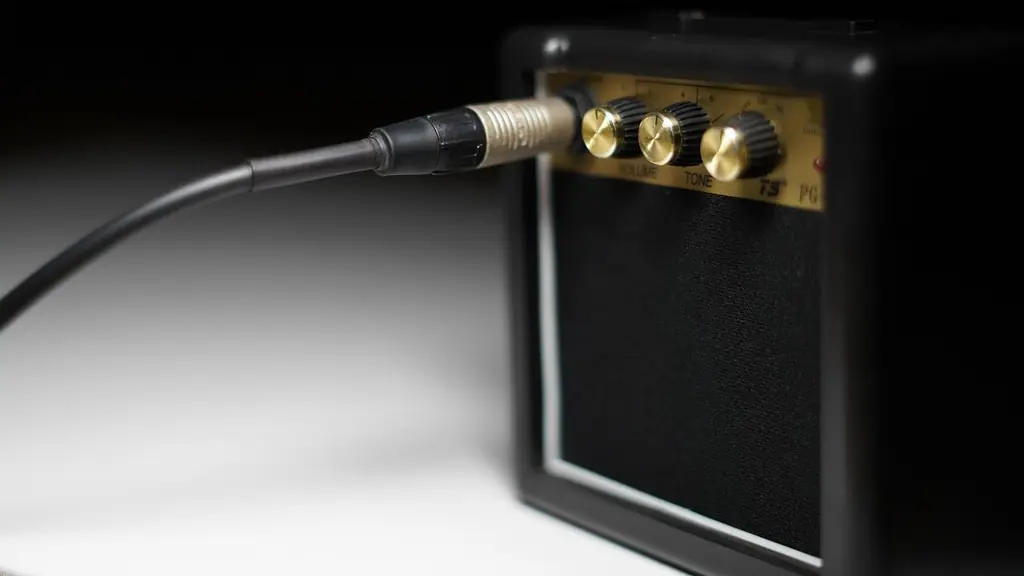
Combo amps put the amplifier and speaker in one cabinet. They are simple to carry and set up, and they are the usual choice for practice and small gigs.
Heads and cabinets separate the amplifier (the head) from the speaker cabinet. This lets you choose or change cabinets, and spreads the weight over two pieces. It also means you must match the cabinet's impedance (in ohms) to the setting on the head, and with a tube head, never switch it on without a cabinet connected.
Speaker size and number affect how an amp sounds and projects. Small practice amps often use speakers of 8 inches (about 20 cm) or smaller; larger combos commonly use 10- or 12-inch speakers, sometimes two or more. Bigger is not automatically better: it is a different balance of bass response, projection and portability. Open-back cabinets spread sound more widely around the room, while closed-back cabinets tend to sound more focused in front of the speaker. Listen to both if you can.
Features worth having (and ones that can wait)
Useful on almost any amp:
- Headphone output. Essential for quiet practice. Check that it sounds good, not just that it exists.
- Two channels or a gain control so you can switch between clean and overdriven sounds.
- Auxiliary input or Bluetooth audio for playing along with recordings.
- Reverb. A little reverb makes practice more pleasant.
Useful for some players:
- Line, DI or USB output for recording directly into a computer. Our guide to recording guitar at home covers how these connect.
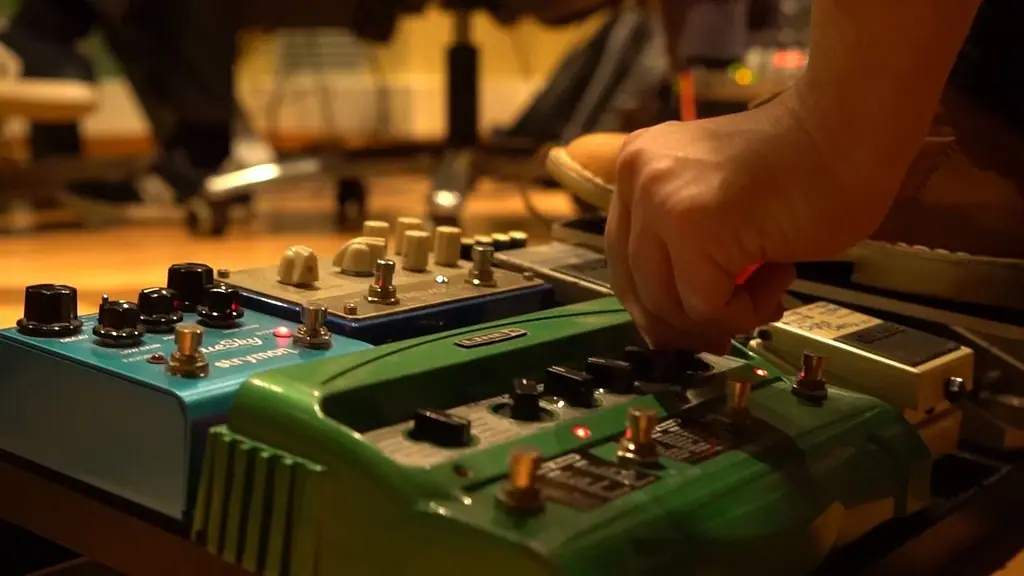
- Effects loop, a send and return that places time-based pedals such as delay and reverb after the preamp. See our effects pedals guide for where each type usually goes.
- Built-in effects and tuner, handy on modeling amps if you do not want a pedalboard yet.
- Power attenuation or low-power modes on some tube amps, which reduce output so you can push the amp at lower volume.
What can wait: footswitches you will not use yet, very high wattage, and large speaker cabinets.
Trying and checking an amp
If you can try an amp before you buy it, bring your own guitar and a list.
- Start quiet. Set everything low, then judge the sound at the volume you will actually use at home.
- Test clean and overdriven sounds. Play chords and single notes on each. Does the clean sound stay clear when you strum harder?
- Try the headphone output with your own headphones.
- Listen for noise. With the guitar volume down, how much hiss or hum is there?
- On a used amp, turn every knob and flick every switch. Scratchy crackles can mean dirty controls; intermittent sound can mean a worn jack. Ask whether a tube amp has had recent service, and be cautious with any amp whose case has been opened by an unknown person.
- Check how it connects to what you already own: pedals, an interface, headphones.
If you are still choosing a guitar too, our guide to choosing an electric guitar explains pickups and other features that interact with the amp, and acoustic or electric for beginners helps if you have not settled on electric yet.
A quick decision checklist
- I know where I will mostly play: home, with others, or recording.
- I have chosen tube, solid-state, modeling or hybrid for practical reasons, not reputation alone.
- I understand that doubling the watts adds only about 3 dB.
- The amp sounds good at the volume I will actually use.
- It has a headphone output if I need to practice quietly.
- If it is a tube head, I have a matching speaker cabinet and know never to run it without a load.
Once you have an amp, the next step is shaping its sound. Our explainer on fuzz, overdrive and distortion is a good place to start, and you will find more in our gear section.
Sources
- Loudness and the "Rule of Thumb" for Loudness, HyperPhysics, Georgia State University
- Decibels, HyperPhysics, Georgia State University
- Using Your Amp Without Speakers Connected: Here's When You Can and Can't, Carvin Audio
- Guitar Amp and Guitar Modeling 101, Yamaha Music Hub
- Deafness and hearing loss: Safe listening, World Health Organization