Gypsy jazz is one of the most recognizable sounds a guitar can make: a pulsing, percussive rhythm section of acoustic guitars and double bass, with a lead guitar or violin flying over the top. It is also a style with its own technique. Players hold the pick differently, strum differently and favor chord types that most beginners never meet in a pop songbook.
If you can already play a few open chords and keep a steady strum, you can start learning it. This lesson introduces the history in brief, the guitars associated with the style, the rhythm called la pompe, the rest-stroke picking approach used for single notes, and the sixth, ninth and minor-sixth sounds that give the style its color. Every exercise is original, and the tempos are deliberately slow.
Where gypsy jazz comes from
The style grew out of the music of Django Reinhardt, a Romani guitarist born in Belgium in 1910. NPR's centennial profile describes how, with no formal training, he created a new style in the 1930s and 1940s that came to be called gypsy jazz, drawing on early American jazz. In 1928 a fire in the caravan where he lived badly burned his left hand; afterward, as NPR puts it, he had full use of only the index and middle fingers of that hand, and he developed a new technique around them.
From 1934, Reinhardt and the violinist Stéphane Grappelli were the principal soloists of the Quintette du Hot Club de France in Paris, a string band of violin, guitars and double bass. That instrumentation, with acoustic rhythm guitars and bass replacing a drummer and piano, still defines the classic gypsy jazz sound. The style is also widely known by its French name, jazz manouche.
Listening: start with recordings of Django Reinhardt and Stéphane Grappelli with the Quintette du Hot Club de France. Listen first to the rhythm guitars rather than the solos: that relentless, even pulse is what you will learn below.
The guitar: Selmer-Maccaferri style
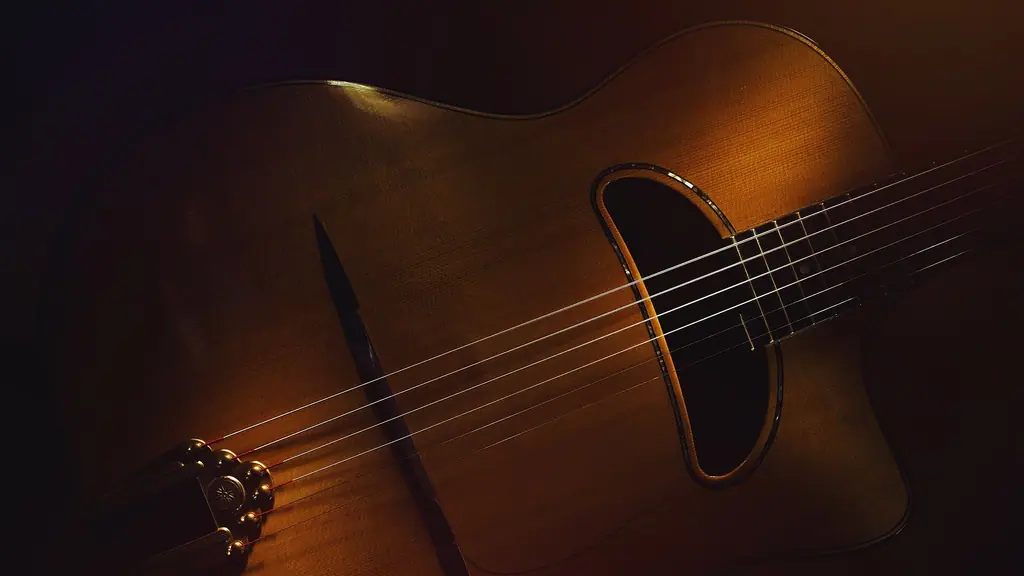
The guitars associated with the style trace back to a design by the Italian luthier Mario Maccaferri, built by the French company Selmer from 1932 to about 1952. Early models had a large D-shaped soundhole (the "grande bouche") housing an internal resonator. By 1936 the definitive version had appeared, with a smaller oval soundhole (the "petite bouche"), no resonator, and a neck joining the body at the 14th fret instead of the 12th. Fewer than 1,000 original Selmer guitars were made.
Today many makers build guitars in this style. In modern bands, lead players often prefer the louder, more cutting oval-hole models, while rhythm players often use D-hole guitars. They are steel-string instruments.
You do not need one to start. Any steel-string acoustic will let you learn la pompe and rest-stroke picking. Expect a lighter, brighter sound than the real thing, and keep your strings in good condition, because the style depends on a crisp attack. Our guide to understanding guitar strings explains gauges and materials.
La pompe: the gypsy jazz rhythm
La pompe (French for "the pump") is the engine of the style. Premier Guitar's primer describes its most basic form as four staccato downstrokes per bar with a slight emphasis on beats 2 and 4. The idea is a short, percussive chord on every beat, with the backbeat snapping a little harder, like a snare drum.
Step 1: four even downstrokes
Set a metronome to 80 BPM. Hold a chord and strum down once per click, letting each strum ring for only part of the beat. Release the pressure in your fretting hand slightly after each strum to cut the sound short.
Step 2: accent and choke beats 2 and 4
Keep beats 1 and 3 a little longer and rounder. On beats 2 and 4, strum slightly more firmly, then immediately relax the fretting-hand pressure so the chord stops. Michael Horowitz's lesson for Premier Guitar describes muting with the left hand straight after beat 2's downstroke.
Count:     1      2      3      4
Stroke:    D      D      D      D
Length:   ring   chop   ring   chop
Accent:           >             >
Step 3 (later): the ghost upstroke
Horowitz also describes a very subtle upstroke on the bass strings a fraction of a second before beats 1 and 3, and likens it to a drummer's hi-hat. It should be barely audible. If it becomes loud and slow, he warns, the rhythm starts to gallop instead of swing. Add it only once steps 1 and 2 feel natural.
Try this: with the metronome at 80 BPM, play la pompe on one chord for two minutes without stopping, focusing only on making beats 2 and 4 short and crisp. Then set the metronome to click on beats 2 and 4 only (40 BPM, treating each click as a backbeat) and play again. Our guide to practicing with a metronome explains this technique.
Chord sounds: sixths, ninths and minor sixths
Gypsy jazz rhythm players rarely use plain major or minor triads. They favor chords with added color, often in compact three- or four-note shapes in the middle of the neck. Interestingly, Reinhardt's injury pushed him toward exactly this kind of compact chord; Wikipedia's biography notes he built his chord approach largely around three-note voicings.
Three families matter most for a beginner:
- Major sixth chords (6): a major triad plus the sixth. G6 contains G, B, D and E. They are often used in place of a plain major chord.
- Dominant ninth chords (9): a dominant seventh plus the ninth. D9 contains D, F♯, A, C and E; on guitar the fifth (A) is often left out.
- Minor sixth chords (m6): a minor triad plus the major sixth. Am6 contains A, C, E and F♯, and Dm6 contains D, F, A and B. These are the signature sound of minor-key gypsy jazz tunes.
Here are two compact, movable shapes to start with, a G6 with its root on the 6th string and a D9 with its root on the 5th string:
Both are movable. Slide the G6 shape up two frets and it becomes A6; slide the D9 shape up two frets and it becomes E9. For open-position alternatives, our chord library also has an open A6, G6 and E9:
Minor-sixth shapes are worth learning from a teacher or a dedicated gypsy jazz method; you can check any voicing you find by naming its notes and comparing them with the formula above (root, minor third, fifth, major sixth).
An original practice progression
This eight-bar loop uses only the two movable shapes, which sit close together on the neck. Play la pompe, four strums per bar:
| G6  | G6  | D9  | D9  |
| D9  | D9  | G6  | G6  |
The G6 shape sits around the 2nd to 4th frets and the D9 around the 4th and 5th, so the change is short. Aim to land each new chord exactly on beat 1 without breaking the pulse. Our guide to changing chords smoothly has drills for clean, on-time changes.
Rest-stroke picking for single notes
For melodies and solos, gypsy jazz guitarists use a picking approach that differs from much modern rock and jazz teaching. Horowitz explains that Reinhardt, like nearly all gypsy guitarists, used a rest-stroke system, which he describes as a flatpick version of the classical and flamenco technique called apoyando. On a rest stroke, the pick goes through the string and comes to rest on the next string, using the weight of a relaxed hand rather than a tight, small motion. He also stresses a floating wrist and a relaxed grip.
A practical starting rule, for this exercise at least: when you move to a higher string, play the first note on the new string with a downward rest stroke; when you play a second note on the same string, use an upstroke.
This original exercise is a G6 arpeggio (G, B, D, E) across the strings. Pick directions are shown under the tab.
e|----------------------------------3-|
B|-----------------------------3--5---|
G|------------------------4-----------|
D|---------------2---5----------------|
A|-------2---5------------------------|
E|---3--------------------------------|
     D   D   U   D   U    D    D  U  D
The notes are G (6th string, 3rd fret), B and D (5th string, 2nd and 5th frets), E and G (4th string, 2nd and 5th frets), B (3rd string, 4th fret), D and E (2nd string, 3rd and 5th frets) and G (1st string, 3rd fret). Play it slowly, letting each downstroke fall through and rest on the next string. Volume and tone should come from the weight of the hand, not from squeezing the pick.
Safety: the heavier attack used in gypsy jazz can tempt you to grip hard and tense your forearm. Keep the hand loose and stop if you feel pain in the wrist or forearm, rather than ordinary tiredness. Short sessions and a gentle warm-up help.
Swing feel and tempo
Gypsy jazz swings: pairs of eighth notes are played long-short rather than evenly, and the rhythm guitar's backbeat locks with the bass. Many tunes are played fast, which is exactly why you should practice slowly. Build up with a metronome in small steps, and only increase the tempo when la pompe stays relaxed and even. Our alternate picking lesson is a useful complement, since you will meet players who mix approaches.
A four-week starter plan
| Week | Rhythm (10 min) | Chords (5 min) | Single notes (10 min) |
|---|---|---|---|
| 1 | La pompe steps 1–2 on one chord, 80 BPM | Learn the G6 and D9 shapes | Rest strokes on open strings, one note per click |
| 2 | Eight-bar progression, 80–90 BPM | Move both shapes up two frets (A6 and E9) | G6 arpeggio ascending, 60 BPM |
| 3 | Add the ghost upstroke; metronome on 2 and 4 | Learn the notes in Am6 and Dm6 | Arpeggio ascending and descending |
| 4 | Play along with a recording, rhythm only | Find G6 and D9 in a second position | Make a short melody from the arpeggio notes |
From here, explore our guide to jazz guitar for beginners, which covers shell voicings and the ii–V–I progression, and our pillar on blues guitar basics, since blues phrasing runs through much of this music too. More styles are collected in our styles section.
Sources
- Django Reinhardt: 100 Years Of Hot Jazz, NPR
- Django Reinhardt, Wikipedia
- Selmer guitar, Wikipedia
- Rhythm Rules: A Gypsy Jazz Primer, Premier Guitar
- Django's Gypsy Jazz Secrets, Premier Guitar (Michael Horowitz)