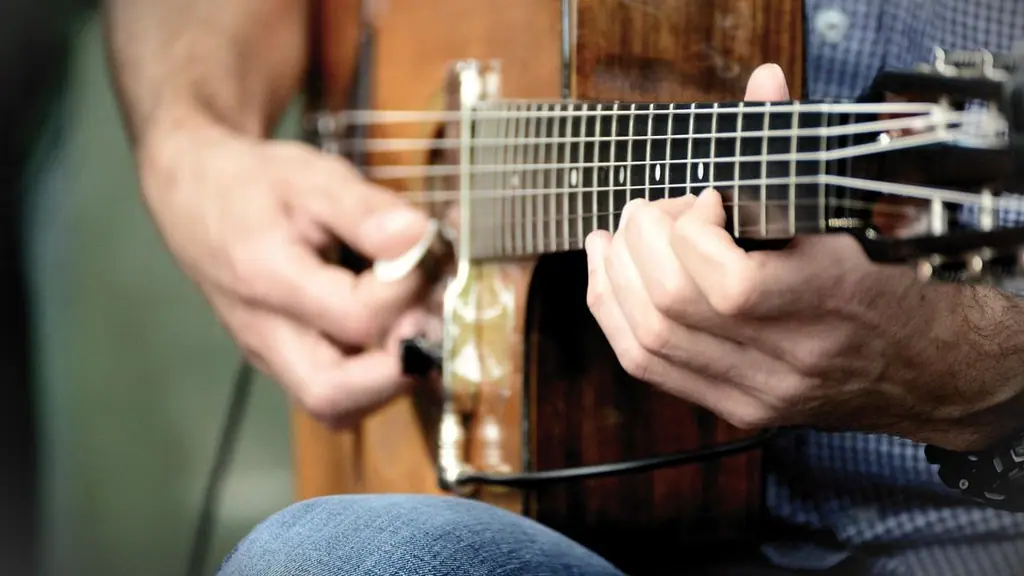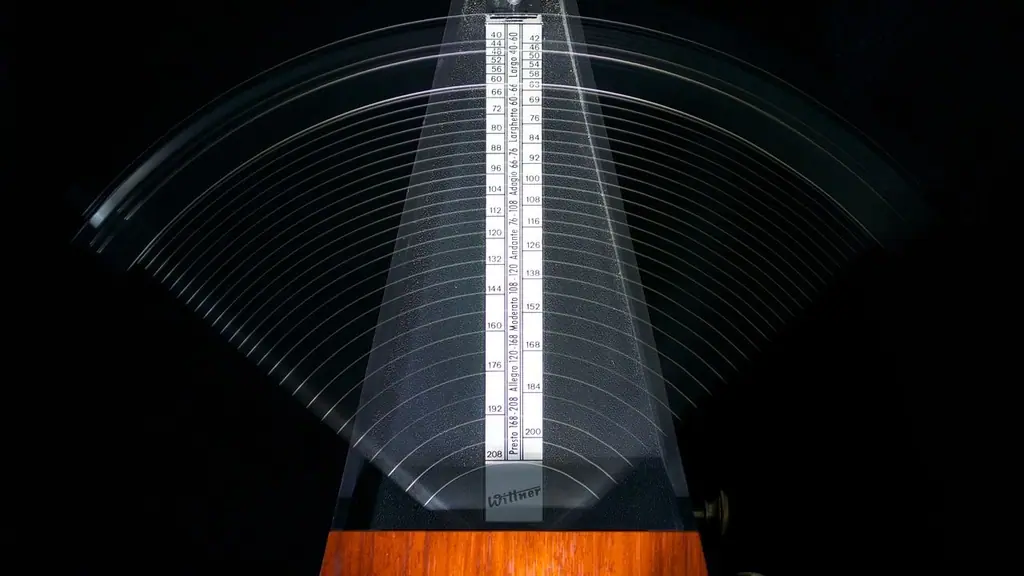
Many guitarists have a complicated relationship with the metronome. It is the most useful practice tool after the tuner, and also the one most often switched on, found irritating, and switched off again within two minutes. The click seems to rush when you drag and drag when you rush, and it is hard to tell whether the problem is you or the machine. (It is always you; the click is steady.)
The trick is to use the metronome for specific jobs rather than leaving it ticking in the background. This lesson explains what the numbers mean, how to count against the click, a set of exercises that build steady time, a reliable method for increasing speed, and when to turn the metronome off. You can follow every exercise with our free online metronome.
What BPM means
A metronome produces a steady pulse measured in beats per minute (BPM). At 60 BPM there is one click per second; at 120 BPM, two clicks per second.
Usually, each click represents one beat: the pulse you would tap your foot to. In most popular music the time signature is 4/4. As the Open Music Theory textbook explains, the top number tells you how many beats are in each bar and the bottom number which note value gets the beat, so 4/4 means four quarter-note beats per bar. Many metronomes can accent the first click of every bar, which helps you keep your place.
A few reference points help when you choose a tempo:
| BPM | Clicks per second | Typical practice use |
|---|---|---|
| 40–60 | under 1 | Learning new chord changes and passages note by note |
| 60–80 | 1 to about 1.3 | Beginner strumming and picking exercises |
| 80–120 | about 1.3 to 2 | Building fluency once a passage is secure |
| 120+ | 2 or more | Fast passages; often easier with the click on half notes |
Counting subdivisions
The click marks the beat, but guitar parts usually move faster than the beat. Dividing each beat into equal parts, called subdivisions, lets you place those faster notes accurately.
| Notes per click | Name (in 4/4) | Count it as |
|---|---|---|
| 1 | Quarter notes | 1, 2, 3, 4 |
| 2 | Eighth notes | 1 &, 2 &, 3 &, 4 & |
| 3 | Eighth-note triplets | 1 trip-let, 2 trip-let ... |
| 4 | Sixteenth notes | 1 e & a, 2 e & a ... |
Count out loud at first. It feels silly, and it is the fastest way to stop rushing.
Try this: set the metronome to 60 BPM. Pick the open 6th string (low E): four bars of quarter notes with down-strokes (one per click), then four bars of eighth notes (two per click, down-up), then four bars of triplets, then four bars of sixteenths. Keep counting out loud the whole time. Take two minutes, and stay relaxed as the notes get faster.
Count:  1   &   2   &   3   &   4   &
Pick:   D   U   D   U   D   U   D   U
e|---------------------------------|
B|---------------------------------|
G|---------------------------------|
D|---------------------------------|
A|---------------------------------|
E|-0---0---0---0---0---0---0---0---|
Five exercises for steady time
1. Land on the click
Strum one chord once on every click for a minute. Listen for the click disappearing under your strum. If you can hear it just before or just after, you are early or late. This sounds trivial; it is the foundation of everything else.
2. Strum through the subdivisions
Keep your strumming hand moving down and up continuously in eighth notes, down on the numbers and up on the "&"s, and choose which strums actually hit the strings. Your hand acts as a second metronome. Our strumming patterns lesson builds whole patterns this way.
3. Change chords on beat 1
Choose two chords and strum four beats on each, changing so that the new chord sounds exactly on the next beat 1. If you are late, the problem is usually that you start moving the fretting hand too late. Lift on the "&" of beat 4.
4. Put the click on 2 and 4
In much rock, pop and soul music, the snare drum accents beats 2 and 4, the backbeat. Yamaha's guide describes placing the clicks on 2 and 4 instead of on every beat. With a basic metronome, set it to half your target tempo and hear each click as beat 2 or beat 4. For a song at 100 BPM, set 50 BPM, count "1 2 3 4" with the clicks on the bold numbers, and play. It feels awkward at first, and that is the point: you have to supply beats 1 and 3 yourself, and the result sounds far more like playing with a drummer.
5. Leave gaps
Both Yamaha articles describe giving the metronome less to do so you rely more on your internal sense of time. Set the click to sound only on beats 1 and 3 (half the tempo) or only on beat 1 of each bar (a quarter of the tempo), or use a metronome that can mute the click for a bar at a time. Play through the silent stretch and see whether you land with the click when it returns. Yamaha also suggests recording yourself to check whether you drift.
Building speed with a speed ladder
Playing a passage faster is mainly a matter of playing it correctly at many tempos in a row. A common method among guitar teachers is a speed ladder:
- Find your clean tempo. Set the metronome low enough that you can play the passage perfectly three times in a row: correct notes, every note clear, relaxed hands.
- Climb in small steps. Raise the tempo by about 4 BPM and play it three times cleanly again.
- Step back when it breaks. As soon as accuracy or relaxation suffers, drop back two steps. That is your working tempo for today.
- Log the number. Write today's highest clean tempo in your practice log. Tomorrow, start a little below it.
- Occasionally jump ahead. Every few days, try the passage for a moment well above your clean tempo, then return to the ladder. It shows you what the target feels like.
Classical guitar teacher Douglas Niedt suggests a related refinement: when a tempo is too fast to follow clicks on every eighth or sixteenth note, set the metronome to click less often, for example on quarter notes or half notes, while keeping the same musical tempo. The Center for Music Learning at the University of Texas at Austin also recommends varying details such as tempo deliberately, which helps make progress stick.
Accuracy first. Repeating a passage with mistakes practices the mistakes. If you cannot play it cleanly at your lowest tempo, simplify it: isolate one bar, or the two notes where the problem is, and ladder that.
Common problems
- You keep rushing. Count out loud, play quieter, and lower the tempo. Rushing is often tension; check your shoulders and grip.
- You cannot hear the click. Turn it up, choose a sharper sound, or use headphones in one ear. With an electric guitar, keep the amp at a moderate volume.
- The click sounds like it is speeding up or slowing down. It is not. You are drifting relative to it. Go back to exercise 1 for a few minutes.
- Slow tempos feel harder than fast ones. That is common: long gaps between clicks demand more control. Very slow practice is an excellent timing exercise in itself; Yamaha's guide even suggests working at 20 BPM as a skill builder.
- Your playing sounds mechanical. Use the metronome less, as below.
When to turn it off
A metronome trains steady time. It does not teach musical phrasing, and music is not always meant to be strictly even. Turn it off:
- Regularly, to check yourself. Play the passage without the click, ideally while recording, then compare with the click.
- When you are working on expression: dynamics, slowing down at the end of a phrase, or the flexible timing (rubato) of some classical and solo fingerstyle music.
- When you play with other people or recordings. Then the drummer, the band or the track is your timekeeper, and listening to them is the skill.
- When you are tired. Five careful minutes beat twenty frustrated ones.
A good balance for most practice sessions is to use the metronome for technique and new material, and to play songs at least once each session without it.
Putting it into your routine
Add a metronome block to every session: two minutes of exercise 1 or 2 during your warm-up, and a speed ladder for whatever you are learning. Note the tempos in your log, so you can see them rise over weeks. Our ready-made beginner routines include tempos for each stage, and our guide to building a practice routine that lasts shows where timing work fits into a balanced session. If reading rhythms is new to you, start with how to read guitar tab and rhythm.
Sources
- Simple Meter and Time Signatures, Open Music Theory (open textbook)
- Creative Ways to Practice With a Metronome, Yamaha
- 4 Essential Metronome Exercises to Improve Your Timing, Yamaha
- The Metronome is Your Friend, Part 2, Douglas Niedt, Classical Guitar Instruction
- Tips for Effective Practice, Center for Music Learning, The University of Texas at Austin