Jazz can feel like a closed door to guitarists who learned on rock, folk or pop. The chord symbols look unfamiliar (Dm7, G7, Cmaj7, C6/9), the music seems to change key every few bars, and the players you hear appear to be doing something completely different with rhythm. Most of that impression comes from a few specific ideas, and each one can be learned on its own.
This lesson gives you those ideas in a sensible order: what seventh chords are and how to read their symbols, compact shell voicings that make jazz chords playable, the ii–V–I progression that runs through so much of the repertoire, swing eighths, and two basic comping rhythms (accompaniment patterns). It finishes with the idea of chord melody and some listening suggestions. Everything is in the key of C, and every example is original.
Seventh chords and their symbols
Most of the chords in jazz are seventh chords: a triad with a fourth note added a seventh above the root. Open Music Theory's chapter on chord symbols explains the convention. A plain "7" means a minor seventh is added, so:
| Symbol | Name | Formula | In C |
|---|---|---|---|
| Cmaj7 (also CM7, C△7) | Major seventh | 1 3 5 7 | C E G B |
| C7 | Dominant seventh | 1 3 5 ♭7 | C E G B♭ |
| Cm7 (also C-7, Cmi7) | Minor seventh | 1 ♭3 5 ♭7 | C E♭ G B♭ |
| Cm7♭5 (also Cø7) | Half-diminished seventh | 1 ♭3 ♭5 ♭7 | C E♭ G♭ B♭ |
You may already know some open-position seventh chords. These three are the ii, V and I chords in C, which this lesson uses throughout:
Shell voicings: the guitarist's jazz shortcut
A four-note seventh chord spread across six strings can be awkward, and in a band it is often too much. Yamaha music educator Luke Thomas, writing about guitar in school jazz bands, points out that the simplest and clearest notes for a chord player to outline are the third and seventh of each chord, and that the guitarist usually leaves the lowest root to the bass player. Open Music Theory's chapter on jazz voicings agrees that leaving out the fifth is almost always acceptable.
That gives us shell voicings: the root, third and seventh only, on three strings, with the string between the root and the others muted. Here are shells for the ii–V–I in C:
- Dm7 (root on the 5th string, 5th fret): D, C, F, which is root, ♭7, ♭3.
- G7 (root on the 6th string, 3rd fret): G, F, B, which is root, ♭7, 3.
- Cmaj7 (root on the 5th string, 3rd fret): C, B, E, which is root, 7, 3.
Strum all six strings lightly and let your fingers mute everything except the three notes. In a band, you might drop the root altogether and play just the two upper notes.
The ii–V–I progression
Open Music Theory calls the ii–V–I one of the most important progressions in jazz. It appears at the ends of tunes and as a building block throughout them. In a major key the chord qualities are always minor seventh, dominant seventh, major seventh, and each chord's root is a fifth above the next: in C, D to G to C.
Play the three shells one after another and follow the thirds and sevenths:
- Dm7 to G7: the seventh of Dm7 (C) falls a half step to B, the third of G7, while the third of Dm7 (F) is kept as the seventh of G7.
- G7 to Cmaj7: the seventh of G7 (F) falls a half step to E, the third of Cmaj7, while the third of G7 (B) is kept as the seventh of Cmaj7. In these shapes the B does not even move: it is the 4th fret of the 3rd string in both chords.
Because these shells alternate between a 5th-string root and a 6th-string root, some of those notes jump an octave as you change shape, but the half-step pull from seventh to third is still easy to hear.
That chain, in which the third of one chord becomes the seventh of the next and each seventh resolves down to the next third, is the smooth voice leading Open Music Theory describes for jazz. It is why ii–V–I sounds so connected, and why shell voicings, which put the third and seventh on adjacent strings, work so well on guitar.
Try this: play the shells in the order Dm7, G7, Cmaj7, Cmaj7, one bar each, strumming once per bar and letting each chord ring. Then play only the two upper notes of each shell and listen for each seventh sliding down to the next chord's third.
Swing eighths
Jazz rhythm feels different largely because of swing. Open Music Theory explains that swing eighths are written as ordinary eighth notes but played unevenly, in a quasi-triplet rhythm in which the first eighth of each beat is roughly twice as long as the second. It also notes that the exact ratio varies from performer to performer and tune to tune, with faster tempos tending to be straighter.
Count it as "1-(and) 2-(and)", leaning on the numbers and making each "and" short and late. One way in is to say "doo-ba, doo-ba" with a longer "doo". Here is an original arpeggio line over the ii–V–I in open position. Play it straight first, then swung, at about 100 BPM:
    1  &  2  &  3  &  4  &    1  &  2  &  3  &  4  &    1  &  2  &  3  &  4  &
e|-------------------------|-----------1--1----------|-------------------------|
B|-----------1--1----------|-----0--3--------3--0----|-------------------------|
G|--------2--------2-------|--0--------------------0-|--------0--4--0----------|
D|--0--3--------------3--0-|-------------------------|-----2-----------2-------|
A|-------------------------|-------------------------|--3-----------------3----|
E|-------------------------|-------------------------|-------------------------|
Bar 1 is Dm7 up and down (D, F, A, C), bar 2 is G7 (G, B, D, F), and bar 3 lands on Cmaj7 (C, E, G, B). Every note is a chord tone, so the line spells out the harmony on its own. Open Music Theory also highlights the backbeat, an accent on beats 2 and 4, as a defining rhythm in jazz; snap your fingers on 2 and 4 while you play.
Comping: accompanying in jazz
"Comping" (short for accompanying) is what a jazz guitarist does most of the time: supporting the soloist and the band with chords. Yamaha's Luke Thomas calls the guitar the "meat in the sandwich," sitting between the bass and the piano, and stresses that sometimes the most musical choice is to stop and listen.
Four to the bar
The classic big-band approach is to play a short chord on every beat, steady and light, with the bass. Thomas notes that this style is often called "Freddie Green style," after Count Basie's longtime rhythm guitarist, and calls it the most basic pattern for jazz guitar comping.
    1  2  3  4    1  2  3  4    1  2  3  4    1  2  3  4
e|-------------|-------------|-------------|-------------|
B|--6--6--6--6-|-------------|--5--5--5--5-|--5--5--5--5-|
G|--5--5--5--5-|--4--4--4--4-|--4--4--4--4-|--4--4--4--4-|
D|-------------|--3--3--3--3-|-------------|-------------|
A|--5--5--5--5-|-------------|--3--3--3--3-|--3--3--3--3-|
E|-------------|--3--3--3--3-|-------------|-------------|
Play each chord short: strum down, then relax the fretting fingers slightly so the chord stops before the next beat. Keep the volume modest and very even, with a slight lift on 2 and 4. The goal is a pulse the band can lean on, not a strummed chord that fills the space.
The Charleston rhythm
A common small-group pattern hits on beat 1 and on the "and" of 2, leaving the rest of the bar open:
    1  &  2  &  3  &  4  &    1  &  2  &  3  &  4  &    1  &  2  &  3  &  4  &
e|-------------------------|-------------------------|-------------------------|
B|--6--------6-------------|-------------------------|--5--------5-------------|
G|--5--------5-------------|--4--------4-------------|--4--------4-------------|
D|-------------------------|--3--------3-------------|-------------------------|
A|--5--------5-------------|-------------------------|--3--------3-------------|
E|-------------------------|--3--------3-------------|-------------------------|
Swing the "and." This short, off-beat stab gives the music a push, and the rests leave room for the soloist.
Chord melody: the next horizon
Chord melody means playing a tune's melody and its harmony at the same time, usually by choosing a chord voicing whose highest note is the melody note. It is how many jazz guitarists play solo arrangements. You can try the idea with what you already know: in the Cmaj7 shell, the top note is E; in the Dm7 shell, it is F; in the G7 shell, it is B. Hum a short melody that uses those notes and play the matching shell under each one. Full chord-melody arranging needs a wider set of voicings, but the principle is that simple.
Gear and tone
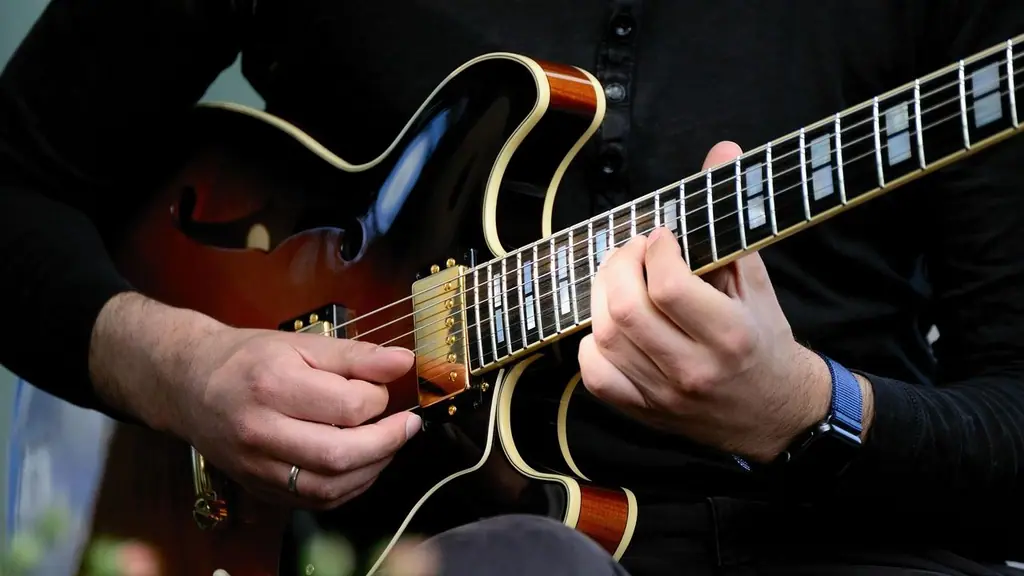
You do not need a special guitar to start. Thomas recommends a clean amp sound with a little reverb, the neck pickup for a warmer tone, and a pick or the thumb for a darker attack; he also notes that a hollow or semi-hollow guitar with humbuckers suits the style. Our guide to electric guitar body styles explains how hollow and semi-hollow guitars differ from solid bodies.
Listening suggestions
Jazz is learned by ear as much as from the page. These are names to search for; listen to how each guitarist comps and swings:
- Charlie Christian
- Freddie Green with the Count Basie Orchestra
- Django Reinhardt (see our gypsy jazz guitar basics)
- Barney Kessel, Kenny Burrell and Jim Hall
- Wes Montgomery and Joe Pass
- Grant Green
A four-week plan
| Week | Focus (15–20 minutes a day, suggested) |
|---|---|
| 1 | Open Dm7, G7 and Cmaj7; read and say each chord's formula |
| 2 | Shell voicings for the ii–V–I; smooth changes at 60 BPM |
| 3 | The swing arpeggio line; four-to-the-bar comping with a metronome on 2 and 4 |
| 4 | The Charleston rhythm; try ii–V–I in other keys by moving the shells |
Moving the shells is easy because they contain no open strings: to play the ii–V–I in F (Gm7, C7, Fmaj7), move the whole set up five frets. If you need to brush up on how chords are built from intervals, our music theory essentials covers triads, keys and numbered chords, and blues guitar basics, the pillar of our styles section, shows how dominant seventh chords drive the twelve-bar blues, a form jazz musicians play constantly. Set your metronome to click on beats 2 and 4 to practice the swing feel.
Sources
- Jazz Guitar for Beginners, Yamaha Music
- ii–V–I, Open Music Theory (open textbook)
- Swing Rhythms, Open Music Theory (open textbook)
- Jazz Voicings, Open Music Theory (open textbook)
- Chord Symbols, Open Music Theory (open textbook)