In many households one person plays the guitar and everyone else listens, or wanders off. That is a shame, because some of the most enjoyable music-making needs no special talent at all: a steady beat on a cereal box, a two-chord song about the family dog, a guessing game with the radio on.
This article is for families with a mix of ages and abilities, from a toddler with a shaker to a parent who knows a handful of chords. It covers how to run a family jam night, how to make simple percussion at home, listening games that work in the car or at the kitchen table, songwriting with your own words, and how to give everyone a part that suits them. Nothing here needs a music teacher in the house.
Setting up a family jam night
A regular, short, low-pressure session works better than an ambitious one-off. Pick a time when nobody is rushing, such as after dinner on a weekend, and aim for 20 to 30 minutes. Stop while people are still enjoying it.
- Tune first. If there is a guitar or ukulele involved, tune it before anyone gathers. An out-of-tune instrument makes everyone sound worse and is easy to fix with a clip-on tuner or our tuning reference.
- Choose one song or groove. One familiar song, or one chord progression played for a while, is plenty. Variety comes from changing who plays what, not from changing songs every two minutes.
- Count in together. Agree on a speed, then have one person count "1, 2, 3, 4" out loud so everyone starts at once. Let children take turns being the counter.
- Give everyone a job. Use the parts table below. Someone can sing, someone can shake, someone can play.
- Swap roles. After a few times through, rotate. The guitarist takes the shaker; the child who was shaking gets to be the "conductor" who signals loud, soft and stop.
- End on purpose. Agree on an ending signal, such as the conductor raising both hands, so the song finishes together instead of trailing off.
Keep the volume friendly. The World Health Organization notes that the risk of hearing damage rises with both loudness and listening time, and suggests keeping levels down and giving ears regular breaks. In a living room, an acoustic guitar and hand percussion are plenty. If there is an amplifier, keep it low enough that people can talk over it.
Parts for every ability
The trick to an enjoyable family band is matching each part to the player, so a beginner never has to keep up with an expert. Here is one way to divide a simple song in the key of G, using the chords G, C and D.
| Player | Part | What they do |
|---|---|---|
| Youngest children | Shaker or drum on the beat | One shake or tap per count, stopping when the conductor signals |
| New guitar learner | Bass notes | One note per bar on the lowest strings (see the tab below) |
| Improving learner | Two-chord strum | Strums only the G and C bars and rests through D, or strums G throughout |
| Confident player | Full chords | Strums G, C, D and G, one bar each, down on every beat |
| Anyone | Voice | Sings the melody or a made-up line, or claps on beats 2 and 4 |
The bass-note part is a satisfying first role for a beginning guitarist, because it is the foundation of the song yet needs only one finger and one note per chord.
        G               C               D               G
e|----------------|----------------|----------------|----------------|
B|----------------|----------------|----------------|----------------|
G|----------------|----------------|----------------|----------------|
D|----------------|----------------|-0---0---0---0--|----------------|
A|----------------|-3---3---3---3--|----------------|----------------|
E|-3---3---3---3--|----------------|----------------|-3---3---3---3--|
   1   2   3   4    1   2   3   4    1   2   3   4    1   2   3   4
The notes are G (6th string, 3rd fret), C (5th string, 3rd fret) and D (open 4th string), which are the root notes of the three chords. If four notes per bar is too many, play just one on beat 1 and let it ring.
Homemade percussion
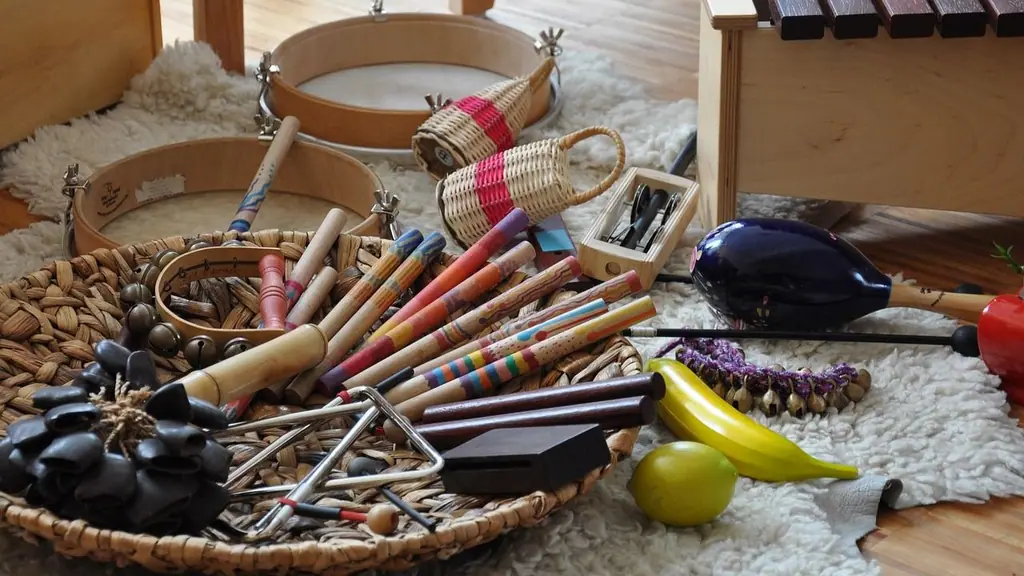
Percussion instruments are the easiest way to include people who do not play anything yet, and making them is an activity in its own right. The open textbook Music and the Child encourages experimenting with sound from everyday surroundings, noting that walls, floors, chairs and other objects all have their own timbres. A few ideas:
- Shakers: dry rice, lentils or beans sealed in a small plastic container or two paper cups taped rim to rim. Different fillings and amounts give different sounds, which is a good experiment on its own.
- Drums: a sturdy cardboard tube or oatmeal-style canister with its lid on, played with hands or a wooden spoon. An upturned plastic bucket gives a deeper sound.
- Scrapers: a ridged plastic bottle stroked with a pencil, in the spirit of a guiro.
- Clappers: two wooden spoons tapped back to back, or two smooth blocks of wood.
Safety: an adult should make and check homemade instruments for young children. Seal shaker lids firmly with tape, because dried beans and rice are a choking hazard for small children, and avoid glass jars, sharp edges and anything heavy enough to hurt if dropped or swung.
Once you have three or four homemade instruments, try layering them the way music teachers build classroom arrangements: one person keeps the steady beat on the drum, another repeats a short pattern on the shaker (a repeated pattern like this is called an ostinato), and a third adds the scraper only at the end of each line. Music and the Child suggests exactly these kinds of layers (a beat, a repeated pattern, a drone) to turn a simple song into something richer.
Listening games
Listening games need no instruments at all, so they work on car journeys and at the dinner table. Choose recorded music of any style the family enjoys.
- Name that family. Musicologists sort instruments by how they make sound. Music and the Child describes this classification: aerophones (air, such as flutes and horns), membranophones (a stretched skin, such as drums), chordophones (strings, such as the guitar and violin) and idiophones (the instrument's own material, such as shakers and woodblocks), plus electronic instruments. Play a track and ask everyone which families they can hear.
- Count the instruments. How many different instruments are playing? Listen again and see whether the answer changes.
- Spot the change. Raise a hand whenever the music changes: gets louder or softer, a new instrument comes in, the singer stops.
- Fast or slow, high or low. For younger children, keep it simple: is this song fast or slow? Is that instrument high or low? Clap along to check the speed.
- Feel the beat. Everyone taps the beat on the table. When the music cuts out (pause it for a moment), keep tapping, then check whether you were still together when it resumes. Our rhythm and coordination activities build on this game.
Writing a family song together
Songwriting sounds advanced, but a family song only needs a repeating chord pattern and some words you make up yourselves. It is also a good way to avoid copyright worries about other people's lyrics.
- Pick the chords. Two chords are enough. E minor and G, or G and C, sound good together and are among the first chords most people learn.
- Find the groove. The guitarist strums four beats on each chord, over and over, while everyone else taps along.
- Choose a subject. Something everyone knows well: the dog, a favorite meal, the school run, a holiday.
- Write line by line. Say each line in rhythm before you try to sing it. Rhymes are nice but optional.
- Repeat a hook. Choose one line to come back again and again, so even the youngest singer can join in.
Here is an example written for this article, to show how simple the words can be. Each line fits four beats of strumming:
Em                      G
Pepper's at the window, waiting by the door,
Em                      G
Shoes are in a pile on the kitchen floor,
Em                      G
Who's going walking? Who's going out?
Em                      G
Pepper knows the answer, Pepper wants to shout.
Record your song on a phone once it settles. Children often enjoy hearing themselves played back, and the recording reminds everyone how it went next time.
Taking music beyond the living room
When the family band feels ready for a wider audience, there are low-pressure options. A performance for grandparents over a video call counts. So does playing on the porch on Make Music Day, held each year on June 21. According to its organizers, it began in France in 1982 as the Fête de la Musique, now takes place in cities around the world, and welcomes musicians of any age or skill level, with every event free and open to the public. Local chapters list events, and anyone can take part.
A month of family music
If you would like a plan, try one focus per week, keeping each session short:
| Week | Focus | Try |
|---|---|---|
| 1 | Get started | Make two shakers and a drum; jam to one song with a steady beat |
| 2 | Listen | Play "name that family" and "spot the change" with music each person chooses |
| 3 | Parts | Learn the G, C and D song with the parts table; rotate roles |
| 4 | Create | Write and record a two-chord family song with your own words |
If a child in the family wants to go further with the guitar, our parent's guide to teaching guitar at home explains how to support regular practice, and the guide to choosing a child's first guitar covers sizes and types. Print a set of chord charts for the music stand, and find more ideas in our kids and families section.
Sources
- Chapter 6: Creative Activity and Lesson Planning, Music and the Child, Open SUNY Textbooks
- Chapter 10: Children's Musical Play: Musicality and Creativity, Music and the Child, Open SUNY Textbooks
- Deafness and hearing loss: Safe listening, World Health Organization
- Make Music Day, Make Music Alliance