An out-of-tune guitar makes everything sound wrong. Chords you have fingered perfectly come out sour, and you can spend days wondering what you are doing badly when the problem is simply the strings. That is why experienced players tune every time they pick up the instrument, and often again in the middle of a session.
This lesson covers standard tuning and what the notes are, how to use a clip-on tuner or app, how to tune the guitar to itself by ear with the 5th-fret method, and how to deal with the problems beginners meet most often. Allow about ten minutes the first time; with practice, it takes under one.
Standard tuning: the six notes
Almost all guitar lessons, chord diagrams and songbooks assume standard tuning. From the thickest string to the thinnest, the open strings are:
E – A – D – G – B – E
Guitarists number the strings from the thinnest: the high E is the 1st string and the low E is the 6th string. The two E strings are two octaves apart. To tell octaves apart, musicians add a number to the note name, so standard tuning is E2, A2, D3, G3, B3 and E4.
| String | Note | Frequency |
|---|---|---|
| 1 | E4 | 329.63 Hz |
| 2 | B3 | 246.94 Hz |
| 3 | G3 | 196.00 Hz |
| 4 | D3 | 146.83 Hz |
| 5 | A2 | 110.00 Hz |
| 6 | E2 | 82.41 Hz |
These frequencies assume the usual reference pitch of A4 = 440 Hz. The physics department at UNSW Sydney gives the rule behind them: in equal temperament, each half step multiplies the frequency by the twelfth root of 2, so the open 5th string (A2, two octaves below A4) vibrates at 110 Hz, and the low E is 82.41 Hz. You do not need the numbers to tune, but they explain why a tuner can show exactly how far off a string is.
You can hear every open string, and check them one by one, on our tuning reference page.
Tuning with a clip-on tuner or app
An electronic tuner is the most reliable method for beginners. D'Addario's guide calls it "certainly the most accurate" option for most players. Clip-on tuners sense vibration through the headstock, so they work even in a noisy room; phone apps use the microphone and need a quiet space. Electric guitars can also plug straight into a pedal or plug-in tuner.
- Clip the tuner on the headstock and switch it on. If it has modes, choose "chromatic" or "guitar".
- Start with the 6th string (low E). Pluck it firmly once and let it ring. Gibson notes that most tuners read more accurately if you pluck again every few seconds rather than letting the note die away.
- Read the note name. The tuner shows the note you are actually playing, not the one you want. If it shows D or D♯ instead of E, the string is too low (flat); if it shows F, it is too high (sharp).
- Turn the tuning key slowly and watch the display. When the letter is right, fine-tune until the needle or light sits in the center.
- Repeat for the 5th, 4th, 3rd, 2nd and 1st strings, aiming for A, D, G, B and E.
- Check all six again. Raising one string adds tension to the neck and can pull the others slightly flat, especially with new strings.
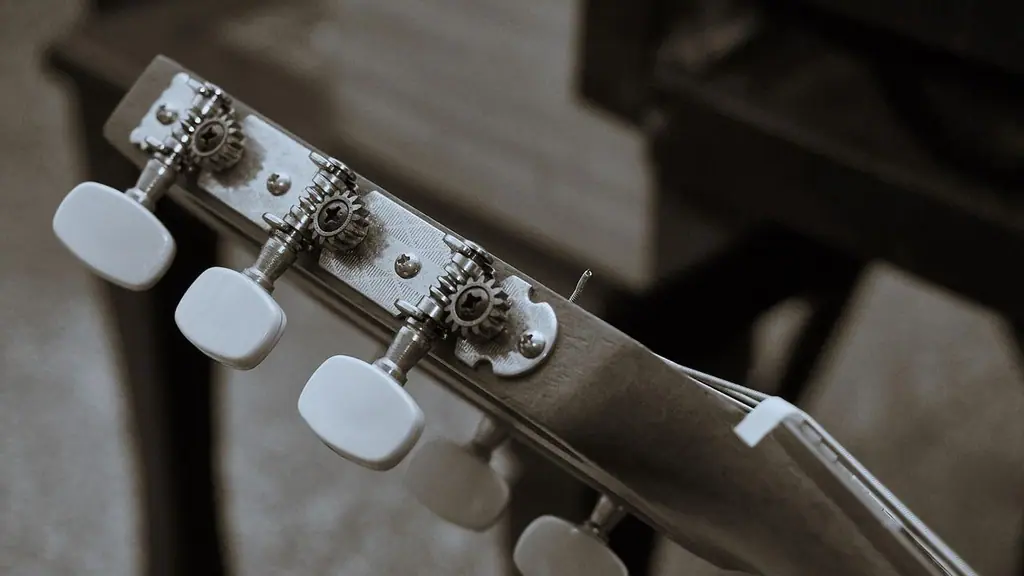
Which way do I turn? It depends on the headstock. On guitars with three tuners per side, the two sides turn in opposite directions to raise the pitch. Don't memorize a direction: turn a little, pluck, and watch whether the reading rises or falls.
Always tune up to the note
When a string is sharp, it is tempting to turn it down until it reaches the note. Yamaha's music-education guidance recommends going slightly below the pitch and then tuning back up instead. Tuning up leaves the string's windings tight around the tuner post; tuning down can leave a little slack that lets the string slip flat as you play.
So the rule is simple: if you overshoot, drop below the note and come back up.
Two more habits help the guitar stay in tune:
- Pluck, then turn. Yamaha's guidance points out that re-striking the string over and over while tuning can make it read sharp. Pluck once, adjust, then pluck again.
- Turn slowly. Gibson warns that quick turns of the tuning key can break strings, particularly on a guitar that has not been played or tuned for a while.
Tuning by ear: the 5th-fret method
If you have no tuner, you can tune the guitar to itself. This is called relative tuning. It works because the note at the 5th fret of each string is the same as the next open string, with one exception.
| Play this fretted note | Match it to this open string | Note |
|---|---|---|
| 6th string, 5th fret | 5th string (A) | A2 |
| 5th string, 5th fret | 4th string (D) | D3 |
| 4th string, 5th fret | 3rd string (G) | G3 |
| 3rd string, 4th fret | 2nd string (B) | B3 |
| 2nd string, 5th fret | 1st string (E) | E4 |
The exception is the G string. The gap between G and B is a major third (four half steps), not a perfect fourth (five half steps) like the others, so you fret the 3rd string at the 4th fret to find B. In tab, the matching pairs look like this:
e|----------------------------0--|
B|----------------------0--5-----|
G|----------------0--4-----------|
D|----------0--5-----------------|
A|----0--5-----------------------|
E|-5-----------------------------|
Read it left to right in pairs: fret 5 on the low E, then the open A; fret 5 on the A, then the open D; and so on.
- Get the 6th string as close to E as you can, from a piano, a keyboard, a tuning app or our tuning reference. Everything else depends on it.
- Play the fretted note, then the open string, and let both ring together.
- Listen for a wobble. When two notes are almost but not quite the same, you hear a slow pulsing, called beating. The closer the pitches, the slower the pulse. Adjust the open string until the pulsing disappears.
- Move to the next pair and repeat.
D'Addario describes relative tuning as a fallback, for a clear reason: each string is tuned only to its neighbor, so if the first string is off, the whole guitar is off. Yamaha's educator guidance makes the same point, suggesting you check at least one string against a tuner so your guitar is in tune with other instruments, not just with itself.
Try this: once a week, tune with the 5th-fret method first, then check each string with a tuner. Write down which strings were off and by how much. Within a few weeks most players find their ear getting noticeably closer, which helps with tuning, singing in tune and playing with others.
Common tuning problems and fixes
- The tuner shows the wrong letter entirely. The string is far from the note, sometimes a whole step or more. Turn slowly toward the right letter, watching the display, and check that you are turning the key for the string you are playing.
- The tuner reads, but erratically. Pluck the string firmly with the other strings quiet, and mute them with your fretting hand if necessary. Gibson also suggests replacing the tuner's battery if readings become unreliable.
- The guitar won't stay in tune. New strings stretch for the first few days; retune often. If old strings will not hold pitch at all, Yamaha's guidance is simple: change them. If a guitar still cannot be tuned, the nut, saddle or setup may need attention from a technician.
- Open strings are in tune but chords sound off. Check that you are not pressing so hard that fretted notes go sharp, and that the guitar's intonation (the saddle position) is correct. A technician can check intonation by comparing the open string with the note at the 12th fret.
- You tuned to the wrong octave. If the string feels very slack or very tight, it may be an octave away from where it should be. Compare it with the tuning reference before turning further.
Safety: a string tuned far too high can snap. If you are unsure, lower the pitch first and come up slowly. Adults should help children with tuning until they know which key belongs to which string.
Beyond standard tuning
Some music uses alternate tunings. The most common is Drop D, where only the 6th string is lowered a whole step from E to D (D2). Others, such as open G or DADGAD, retune several strings. Gibson's advice for beginners is to master standard tuning first, and that is sound: every chord shape in our chord library assumes it.
Make tuning part of every session
Tuning is the first step in the four-week plan in how to start learning guitar, and it should open every practice session. Tune, play a chord you know, and listen. Over time you will start hearing when a single string has drifted, before you even look at the tuner. If you are still learning the names of the strings and parts, our guide to the parts of the guitar will help.
Sources
- Tuning a Guitar, Yamaha Music Educator Hub
- Guitar String Tuning 101, D'Addario
- Understanding Guitar Tuning, Gibson
- Note Names, MIDI Numbers and Frequencies, School of Physics, UNSW Sydney